Category: Uncategorized

  • The Great Patient Handover: How to Transition Beneficiaries Without Triggering an “Abandonment” Audit

    The Great Patient Handover: How to Transition Beneficiaries Without Triggering an “Abandonment” Audit

    The contracts are signed. The winners are announced.

    Now comes the mess.

    If you are a “Non-Contract Supplier” (you lost the bid), and you chose not to grandfather your patients, you have approximately 60 days to move them to a Winner.

    This is not just a logistics problem; it is a legal one.

    If a patient runs out of oxygen on January 2nd because you picked up your equipment and the new provider didn’t arrive, you are liable.

    CMS views “disruption of service” as a quality of care violation. The OIG (Office of Inspector General) views it as potential patient abandonment.

    At Wonder Worth Solutions, we are helping providers navigate this “Great Handover.” The goal is to exit the relationship gracefully without burning bridges with patients or referral sources.

    You cannot surprise a patient.

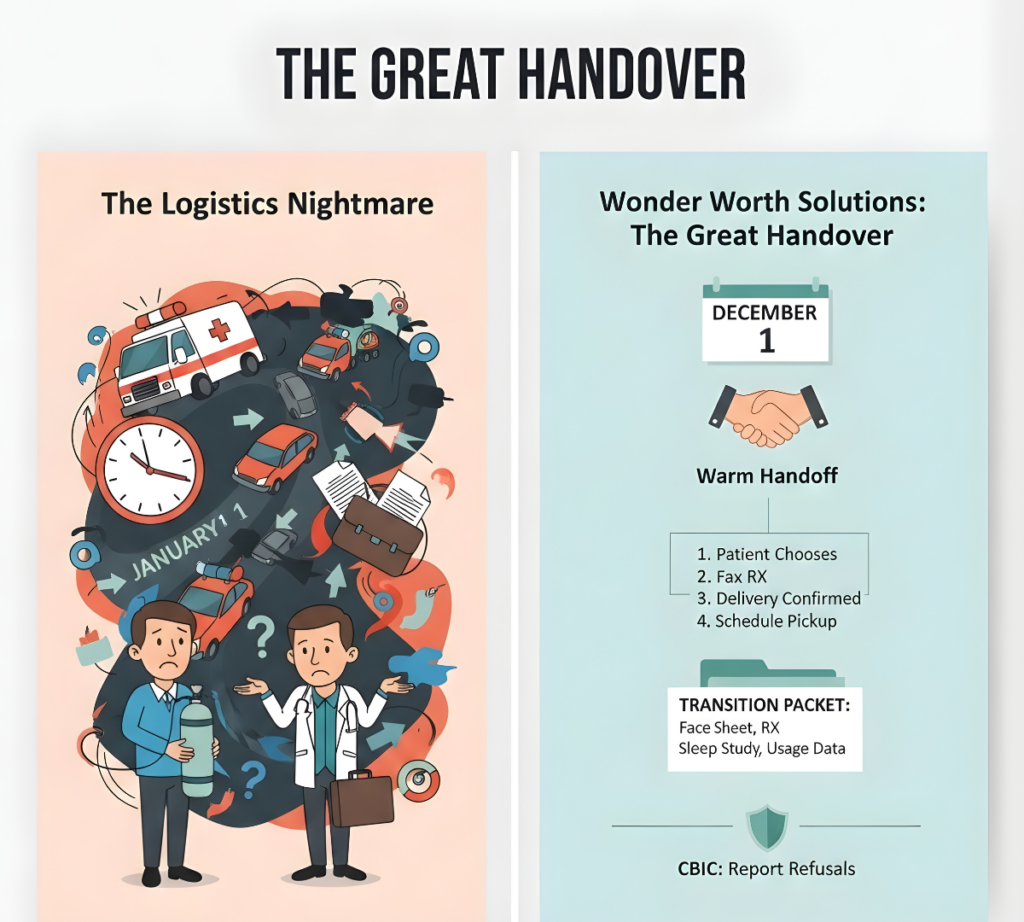
    • The Rule: You must provide 30 Days Written Notice before stopping service.
    • The Date: If the contract starts Jan 1, your letters must go out by December 1st.
    • The Content: The letter must explicitly state:
      1. We are no longer the Medicare supplier.
      2. You must choose a new supplier from the enclosed list (The Winners).
      3. We will pick up our equipment on [Date].

    You cannot force the patient to go to a specific winner (even if you have a deal with them). You must provide the list of all Contract Suppliers in the area and let the patient choose.

    • Tip: Most patients won’t choose. They will ask, “Who do you recommend?” You can recommend a partner, but you must document that the patient agreed.

    You cannot just drop the patient. You must ensure the new supplier accepts them.

    • Step 1: The Patient picks a new supplier.
    • Step 2: You fax the Current Prescription (CMN/DIF) and the Last Clinical Notes to the new supplier.
    • Step 3: You get a “Date of Delivery” confirmation from the new supplier.
    • Step 4: You schedule your pickup for after their delivery.
    • Scenario: The Winner delivers on Jan 1st. You pick up on Jan 3rd.
    • The Cost: You cannot bill for those 3 days. That is the cost of doing business. Do not pick up before the new equipment arrives. If the patient ends up in the ER without oxygen, it is your fault.

    What if the Winner doesn’t want your patient?

    • The Law: Contract Suppliers must serve all beneficiaries in the CBA. They cannot discriminate based on geography or acuity.
    • The Tactic: If a Winner refuses to take a referral because the patient lives “too far out,” you must report this to the Competitive Bidding Implementation Contractor (CBIC). Document the refusal. This protects you from abandonment claims.

    To make the transition smooth, you need to transfer data cleanly.

    • The Packet: Create a standard “Transition Packet” for each patient:
      • Face Sheet.
      • Current RX.
      • Most recent Sleep Study / Oxygen Saturation test.
      • Usage compliance download (for CPAP).
    • The Value: If you make it easy for the Winner to intake your patients, they are more likely to prioritize your transfers over others.
    Flowchart of a compliant Medicare DME patient handover process

    Transitioning 500 patients in 60 days is an administrative crush. Wonder Worth Solutions acts as your Transition Coordinator.

    • Letter Campaigns: We draft and mail the compliant 30-Day Notices.
    • Intake Coordination: We call the new suppliers to confirm acceptance and delivery dates.
    • Documentation: We archive the “Proof of Transfer” so you are audit-proof against abandonment claims.

    Dreading the handover?

  • Why Your Contracting Team Drowns in April: The Case for Seasonal Resource Allocation

    Why Your Contracting Team Drowns in April: The Case for Seasonal Resource Allocation

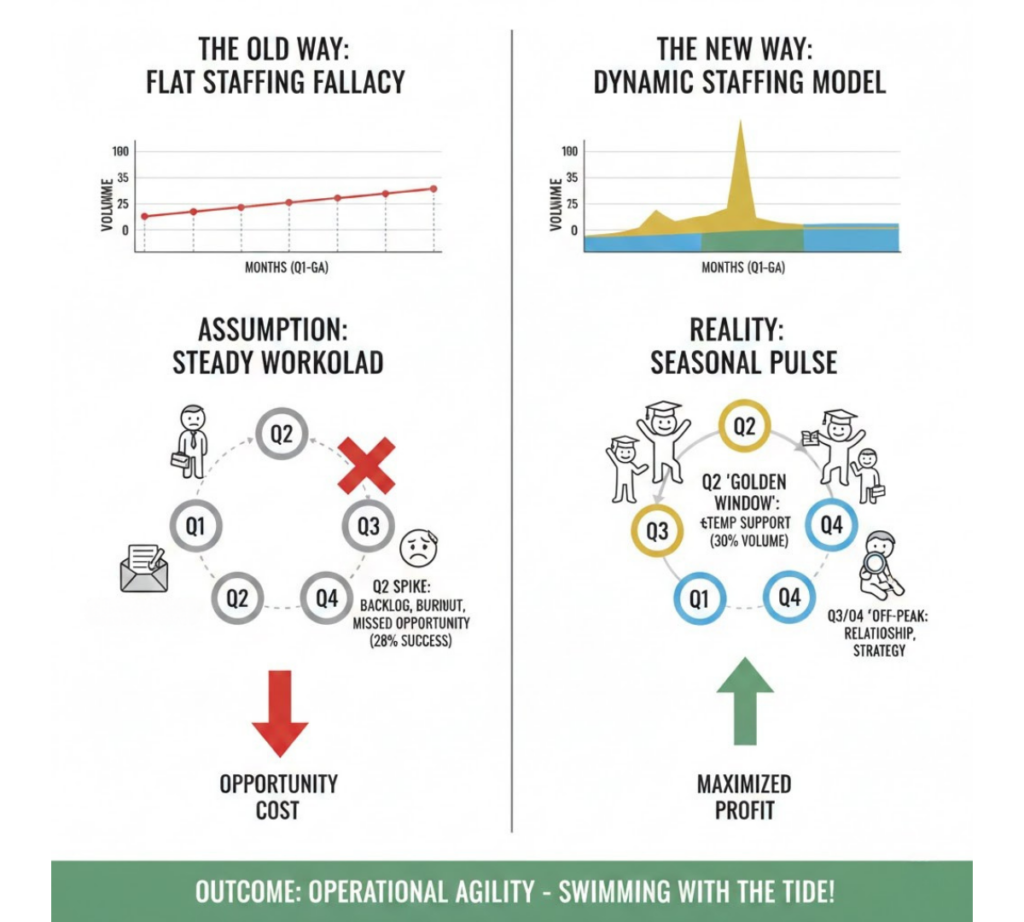
    For years, the contracting department operated on a “Flat Staffing” model. They maintained the same headcount and resource allocation in December as they did in May. Management assumed that payer contracting was a steady, year-round activity.

    But every Spring, the team fell apart. Backlogs grew, emails went unanswered, and burnout spiked. Leadership blamed “inefficiency,” but the data told a different story.

    The failure wasn’t laziness; it was Seasonality. Our deep-dive statistical analysis revealed that the contracting market has a distinct pulse that the provider was ignoring.

    Data showed that 30% of all applications are initiated in Q2 (April–June). This is the industry’s “Rush Hour,” likely driven by new fiscal year budgets and network expansion plans.

    • The Opportunity: Crucially, Q2 also boasts the highest success rate of the year at 28%.
    • The Miss: By staffing Q2 the same as Q4 (which sees only 17% volume), the provider was bottlenecking their most profitable window.

    Because the team was overwhelmed during the surge, they couldn’t devote enough attention to follow-ups. High-potential applications were slipping through the cracks during the exact months they were most likely to close.

    WWS introduced a Dynamic Staffing Model similar to how retail manages the holiday season.

    We reclassified Q2 as the “Golden Window.” We adjusted the annual resource plan to shift capacity from the slower Q4 months to Q2.

    • Action: We recommended increasing staffing and utilizing temporary support during the April–June surge to handle the 30% volume spike.

    For Q3 and Q4, where success rates naturally drop to 20%, we developed “Maintenance Strategies” focused on relationship building and long-term pipeline management, rather than aggressive submission targets.

    Graph comparing seasonal contracting volume vs success rates.

    The result was Operational Agility. By matching resources to the market’s natural rhythm, the provider maximized contract captures during the high-yield months and used the slow months for strategic planning. We stopped fighting the tide and started swimming with it.

  • The “Grandfathering” Clause: How to Keep Your Patients If You Lose the Bid

    The “Grandfathering” Clause: How to Keep Your Patients If You Lose the Bid

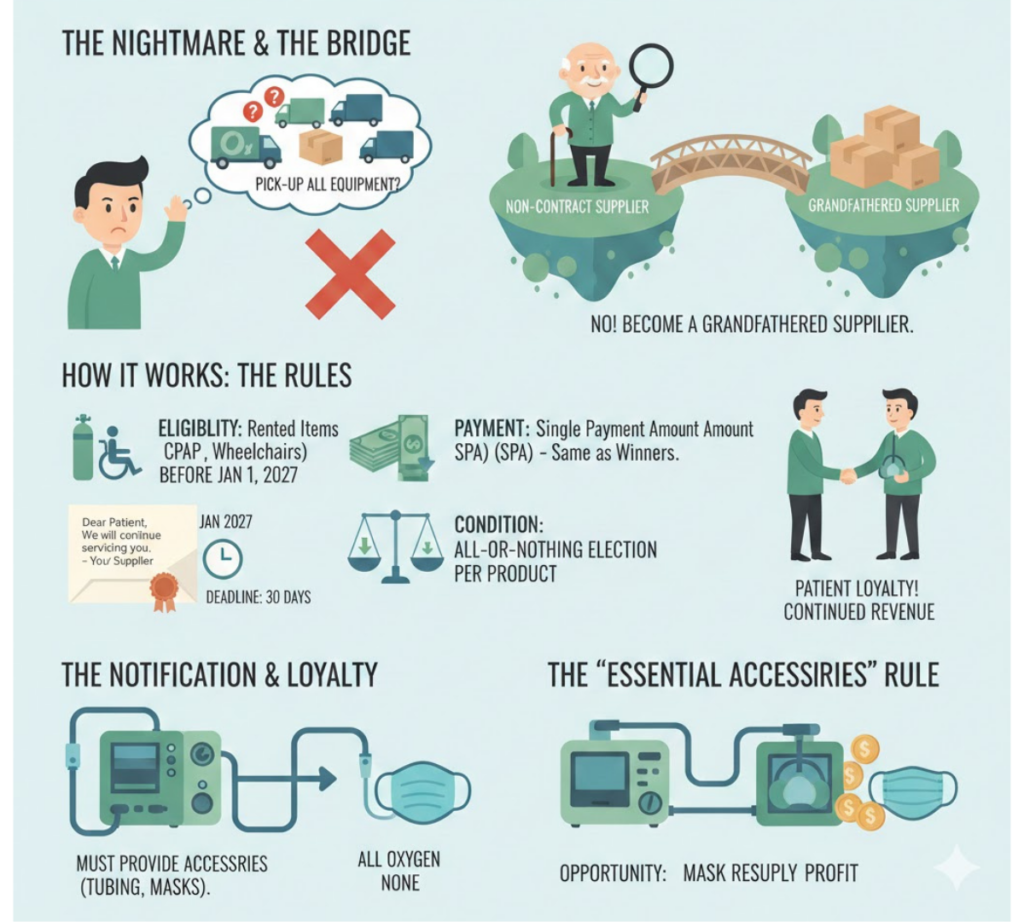
    “I lost the bid. Do I have to go to 500 homes and pick up my equipment on December 31st?”

    This is the nightmare scenario.

    The Answer: No.

    To protect beneficiaries from disruption of care, CMS allows non-contract suppliers to become “Grandfathered Suppliers.” This is your bridge to survival.

    • The Eligibility: It only applies to Rented Items (Oxygen, CPAP, Hospital Beds, Wheelchairs) where the patient was on claim before January 1, 2027.
    • The Payment: You are paid the Single Payment Amount (SPA)—the same price the winners get. You do not get to keep your old higher rate.
    • The Condition: It is an “All-or-Nothing” election per product category. You must accept all your grandfathered Oxygen patients or none. You cannot cherry-pick the profitable ones and dump the rural ones.

    You must formally elect to be a Grandfathered Supplier.

    • The Deadline: This usually must be done within 30 days of the contract period start.
    • The Patient Letter: You are required to send a letter to your patients stating: “We are no longer the contract supplier, but we have chosen to continue servicing you.”
    • The Outcome: This builds loyalty. Patients hate switching providers. If you keep them, you keep the revenue stream (and the resupply revenue for CPAP).
    • The Trap: If you grandfather the Oxygen Concentrator, you must also provide the tubing and masks. You cannot say “I’ll rent the machine, but go buy your masks from the Winner.”
    • The Opportunity: If you keep the CPAP rental patient, you also keep the mask resupply revenue, which is often where the real profit lies.
    Flowchart for DME grandfathering election process

    Keeping your patients?

  • M&A Strategy: Buying a “Winner” vs. Selling a “Loser” in the Contract Phase

    M&A Strategy: Buying a “Winner” vs. Selling a “Loser” in the Contract Phase

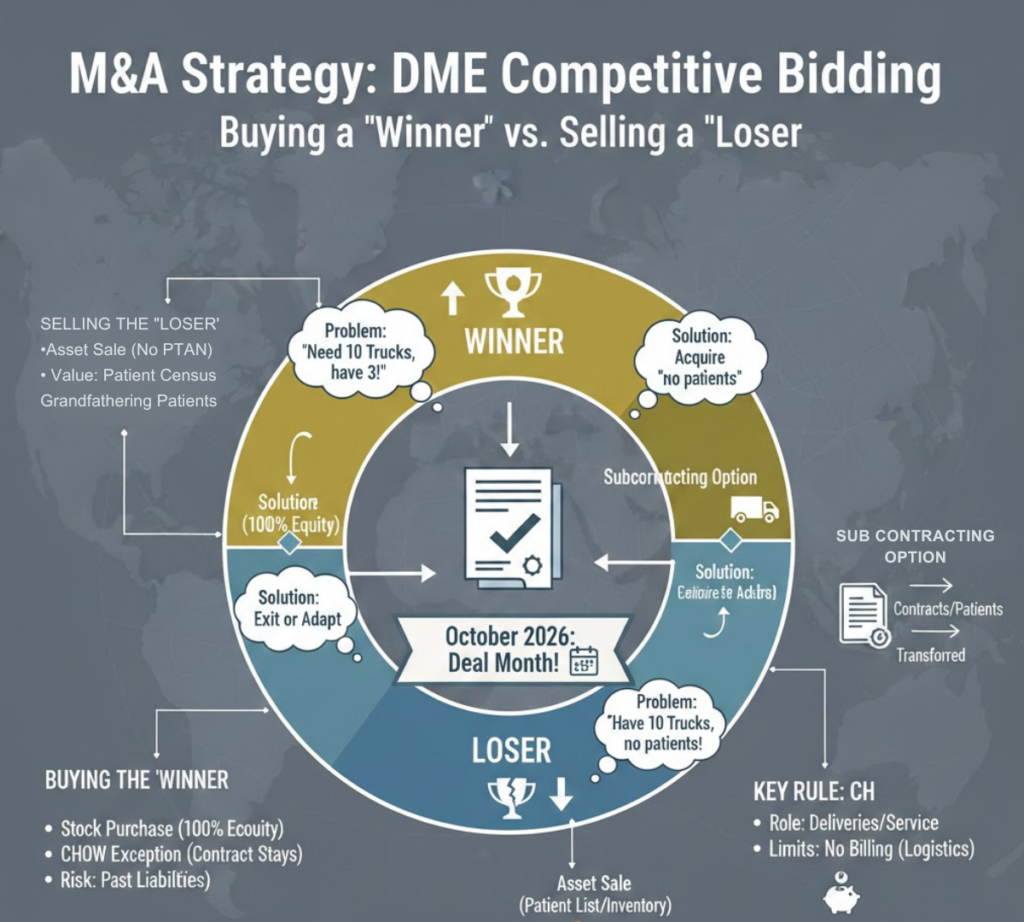
    October 2026 is not just “Contract Month.” It is “Deal Month.”

    The moment contract offers go out, phones start ringing.

    • The Winner’s Problem: “I won the contract for the whole city, but I only have 3 trucks. I need 10 trucks by January 1st.”
    • The Loser’s Problem: “I have 10 trucks and 500 patients, but I can’t bill Medicare after December 31st.”

    The solution is obvious: Consolidation. But Medicare M&A is tricky. You can’t just buy the trucks; you have to navigate the federal rules on transferring contracts.

    If you lost the bid and want to exit the market:

    • The Asset Sale: You generally cannot sell your PTAN if it doesn’t have a contract. Instead, you sell your Assets(Patient List, Inventory, Phone Number).
    • The Value: Your value is your active patient census. The Winner wants to buy your patients to migrate them to their contract.
    • The Grandfathering Leverage: You can elect to grandfather your patients, keep the revenue for a few months, and then sell the patient list slowly to maximize value.

    If you lost the bid but are determined to stay in the market:

    • The Stock Purchase: You cannot simply “buy the contract.” You must buy the Stock (100% equity) of the company that won the contract.
    • The CHOW Exception: Under CMS rules, if you buy the stock, the provider entity remains the same, and the contract stays intact.
    • The Risk: When you buy the stock, you inherit all the past liabilities. If that company committed fraud 3 years ago, you just bought the fine. Due diligence is critical.

    If you don’t want to sell, you can become a Subcontractor.

    • The Role: You contract with the Winner to perform deliveries and service on their behalf.
    • The Limits: You generally cannot do the billing. The Winner bills Medicare; you bill the Winner. It turns you into a logistics company, but it keeps your trucks moving.
    Comparison chart of DME Stock vs Asset sales for Medicare contracts.

    Whether you are buying or selling, the paperwork determines if the cash flow survives the deal. Wonder Worth Solutions handles the CHOW (Change of Ownership) paperwork in PECOS. We ensure the NPIs, PTANs, and EFT agreements transfer correctly so billing doesn’t stop during the handover.

    Buying or Selling?

  • The “90% Rule”: When You Must Accept a Contract to Save Your Business

    The “90% Rule”: When You Must Accept a Contract to Save Your Business

    “The price is too low. I’m rejecting it on principle.”

    That is a brave statement. But can you afford to be brave?

    If you are a diversified DME with a healthy mix of Commercial Insurance, Hospice, and Cash Sales, you can afford to walk away from a bad Medicare deal. You have other levers to pull.

    But if you are a traditional Oxygen or Sleep provider where Medicare makes up 90% of your billing, walking away doesn’t send a message to CMS. It just turns off the lights in your warehouse.

    Before you click “Reject,” run a Payer Mix Report by Product Category for the last 12 months.

    • Oxygen: Is Medicare > 60%?
    • CPAP: Is Medicare > 40%?
    • Standard Mobility: Is Medicare > 80%?
    • The Reality: If you are above these thresholds, you do not have a “choice.” You have a mandate. You must sign the contract to keep the cash flow moving, even if the margin is thin.

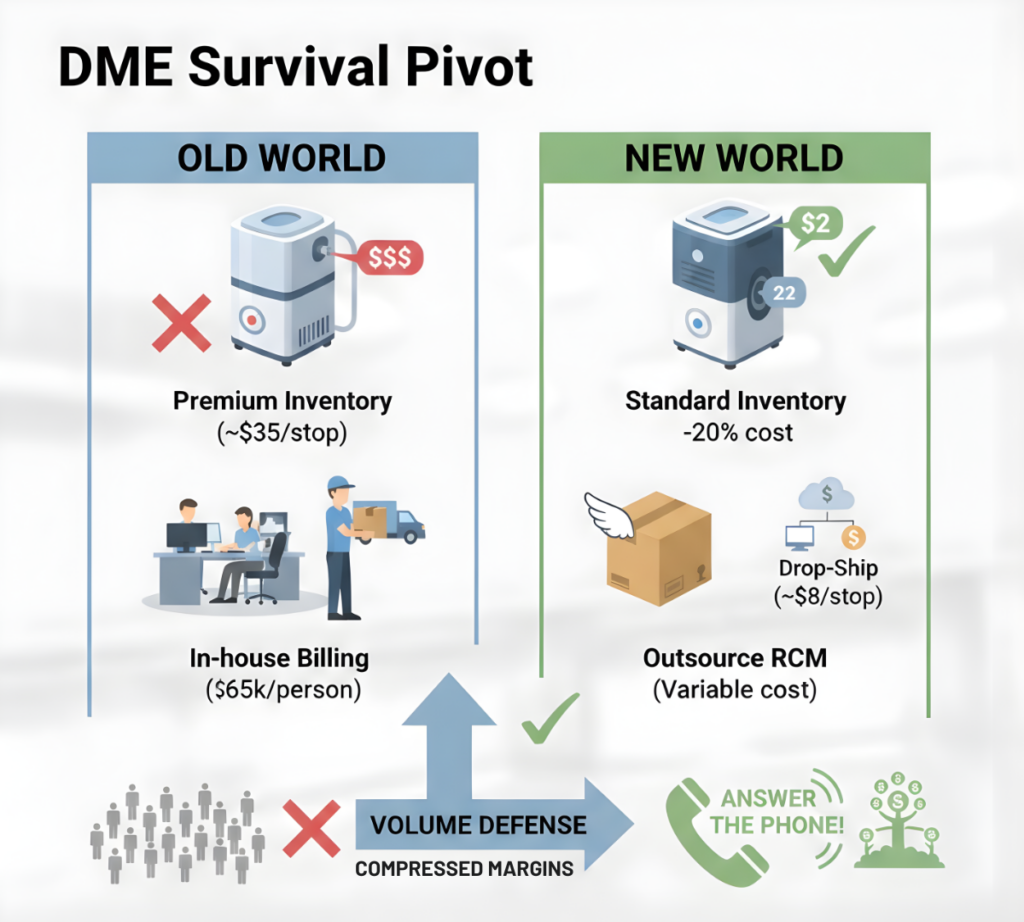
    If you accept a contract with compressed margins, you cannot operate “business as usual.” You must radically alter your cost structure.

    • Old World: You provided the premium, ultra-quiet Oxygen Concentrator because patients liked it.
    • New World: You provide the “Standard” model that meets the medical necessity requirement and costs 20% less. You cannot subsidize premium equipment on a standard reimbursement rate.
    • Old World: You had drivers delivering monthly supplies to the doorstep.
    • New World: You move to 100% Drop-Ship. The cost of a driver + truck + gas is ~$35 per stop. The cost of shipping is ~$8. You must eliminate the fleet for non-setup items.
    • Old World: You have an in-house billing team costing $65k/year per person.
    • New World: You outsource RCM. If your reimbursement drops by 15%, your overhead must drop by 15%. Outsourcing RCM converts a fixed salary cost into a variable cost that scales with your (lower) revenue.

    The only upside to a low-margin contract is Volume.

    • With 70% of competitors likely being eliminated from the market (losers), the Winners will see a surge in referrals.
    • The Strategy: You must be ready to capture all of this volume efficiently. If you sign the contract but fail to answer the phone because you cut staff too deep, you will fail.
    Payer mix report highlighting high Medicare dependency thresholds

    If you have to accept a lower reimbursement, you must lower your Operational Expense (OPEX). Wonder Worth Solutions is the OPEX cutter. We take over RCM, Credentialing, and Intake at a fraction of your in-house cost, making the low-margin contract profitable again through sheer efficiency.

    Forced to sign?

  • The Contract Offer Arrives: The Ultimate Guide to Analyzing Your “Single Payment Amount” (SPA) Before You Sign

    The Contract Offer Arrives: The Ultimate Guide to Analyzing Your “Single Payment Amount” (SPA) Before You Sign

    You survived the registration in June. You survived the bid submission in July. You survived the disqualification audit in September.

    Now, the email is here.

    Subject: CMS Competitive Bidding Program – Contract Offer Notification.

    You log into Connexion. You click “View Offer.”

    And there it is: The Price.

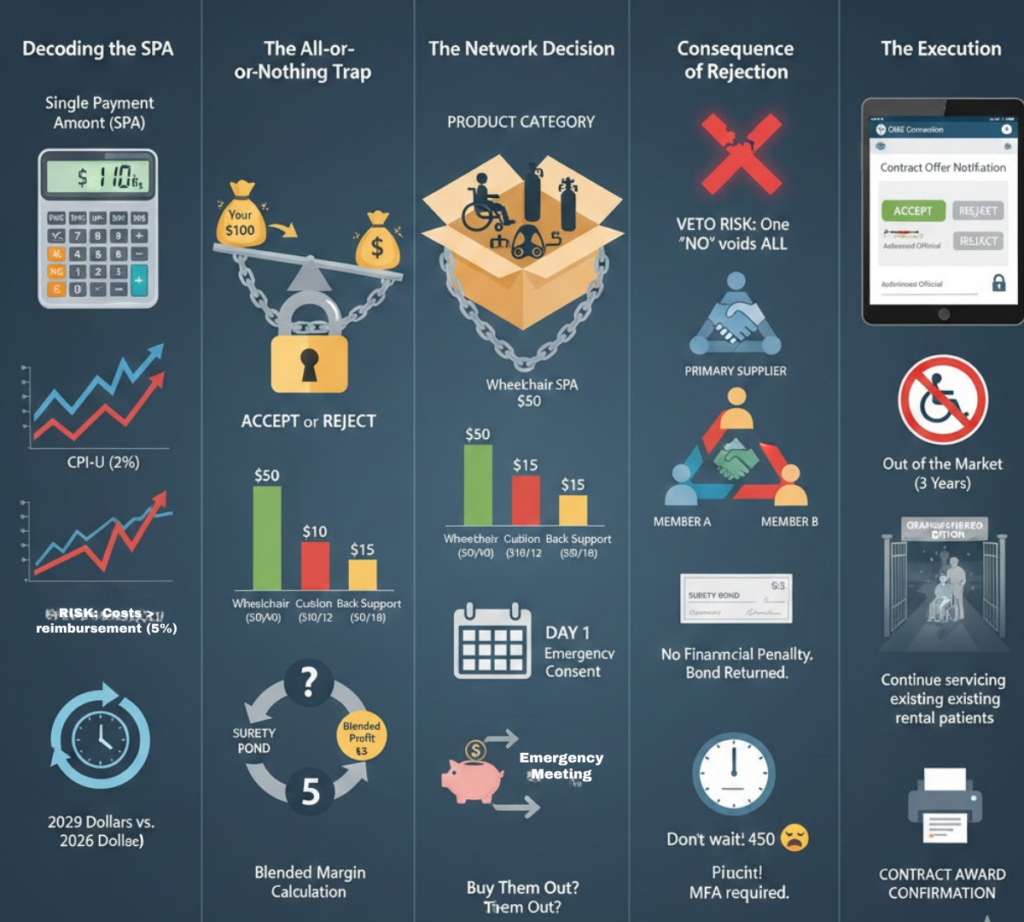
    For the next three years (Jan 1, 2027 – Dec 31, 2029), this is what Medicare will pay you for a wheelchair, an oxygen concentrator, or a CPAP machine.

    There is no negotiation. You cannot counter-offer. You cannot say, “I’ll take the Oxygen but not the CPAP.” You have two buttons: ACCEPT or REJECT.

    And you typically have 10 business days to decide.

    History tells us that 15% of providers sign contracts that eventually bankrupt them. They see the volume (“I’ll get 1,000 new patients!”) and ignore the margin (“I lose $5 on every delivery”). They assume they can “make it up on volume.” In the DME industry, you cannot make up a negative margin on volume; you just go broke faster.

    At Wonder Worth Solutions, we believe a bad contract is worse than no contract. Here is how to analyze the offer before you sign your life away.

    The price you see on the screen is likely different from the price you bid. Why?

    Under the new rules finalized for the 2026 Round, CMS sets the SPA at the 75th Percentile of all winning bids (clearing price).

    • Your Bid: $100.
    • The Range: The winning bids ranged from $80 to $120.
    • The SPA: The 75th percentile is calculated at $110.
    • The Result: Even though you bid $100, you are offered a contract at $110. This feels like a victory.
    • Your Bid: $120.
    • The SPA: The 75th percentile is $110.
    • The Offer: CMS offers you the contract at $110.
    • The Decision: You must decide if you can operate at $10 less than your calculated “break-even” bid.

    Do not look at the SPA in a vacuum. You must look at it relative to 2029 dollars, not 2026 dollars.

    • The CPI-U Adjustment: The 2026 contract includes an annual inflation adjustment. However, this is based on the Consumer Price Index for All Urban Consumers (CPI-U).
    • The Risk: Medical inflation (staffing, gas, insurance) often outpaces general CPI. If your costs go up 5% a year, but the reimbursement only goes up 2%, a profitable contract in Year 1 becomes a losing contract in Year 3.

    Competitive Bidding is an “All-or-Nothing” game within a Product Category.

    If you bid on “Standard Mobility,” the contract offer covers every HCPCS code in that category—walkers, wheelchairs, cushions, leg rests, and drive controls.

    Remember the “Lead Item” pricing from July? Now you see the result.

    • Lead Item (K0001 Wheelchair): The SPA might look healthy.
    • Non-Lead Item (Seat Cushion): Because of the historical ratios used by CMS, the cushion price might be devastated.

    You cannot just look at the wheelchair price. You must calculate the Blended Margin of a standard order.

    • Example Order: 1 Wheelchair + 1 Cushion + 1 Back Support.
    • SPA Revenue: $50 (Chair) + $10 (Cushion) + $15 (Back) = $75 Total.
    • Your Cost: $40 (Chair) + $12 (Cushion) + $18 (Back) = $70 Total.
    • Net Profit: $5.00.

    Is $5.00 enough to cover the intake time, the driver’s gas, the billing cost, and the compliance risk? If you only looked at the Wheelchair line item, you missed the losses on the accessories.

    If you bid as part of a Network (Consortium), the stakes are higher during the signing phase.

    • The Primary Supplier: Must sign the contract first.
    • The Member Suppliers: Must also sign the contract individually.
    • The “Veto” Risk: If even one member of your network refuses to sign (perhaps because the price is too low for them), the Entire Network Contract is voided. You all lose.

    Convene an emergency meeting with your partners on Day 1 of the offer window. Show them the Blended Margin analysis. You need unanimous consent immediately. If one partner is hesitating, you have 9 days to convince them or buy them out.

    What happens if you look at the math and click REJECT?

    You cannot bill Medicare for these items in this Competitive Bidding Area (CBA) for 3 years. You are effectively “fired” from this product line for Medicare beneficiaries.

    Unlike “Forfeiture” (which happens if you sign the contract and then default on it), rejecting the initial offer carries no financial penalty.

    • You get your Surety Bond back.
    • You are not “blacklisted” from future rounds.

    Rejecting the contract does not mean you have to abandon your current patients immediately. You may be able to elect “Grandfathered” status for rental items (Oxygen, Capped Rental DME). This allows you to keep servicing existing patients at the new SPA rate, preserving your residual revenue stream while you pivot your business model.

    If you decide to sign, do not leave it until 4:55 PM on Day 10. Connexion servers will slow down.

    1. Log in as the Authorized Official (AO). Only the AO can sign.
    2. Verify the CBA List: Ensure every CBA you won is checked.
    3. Electronic Signature: You will likely need to re-authenticate with MFA.
    4. Print the Confirmation: Once signed, print the “Contract Award Confirmation” screen. This is your legal proof.
    Diagram showing the 10-day timeline from contract offer notification to final acceptance/rejection

    Do not sign a federal contract based on gut feeling. Wonder Worth Solutions offers a “Contract Viability Analysis.”

    • SPA vs. COGS: We load the offered prices into our proprietary calculator against your current invoice costs to show the real margin.
    • Inflation Stress Test: We forecast the profitability in Year 2 and Year 3 using different inflation scenarios.
    • Go / No-Go Recommendation: We give you a data-driven opinion: Sign and Restructure, or Reject and Pivot.

    The clock is ticking

  • The “Dual Eligible” Compliance Trap: Why Automatic Crossover Billing is a Compliance Risk

    The “Dual Eligible” Compliance Trap: Why Automatic Crossover Billing is a Compliance Risk

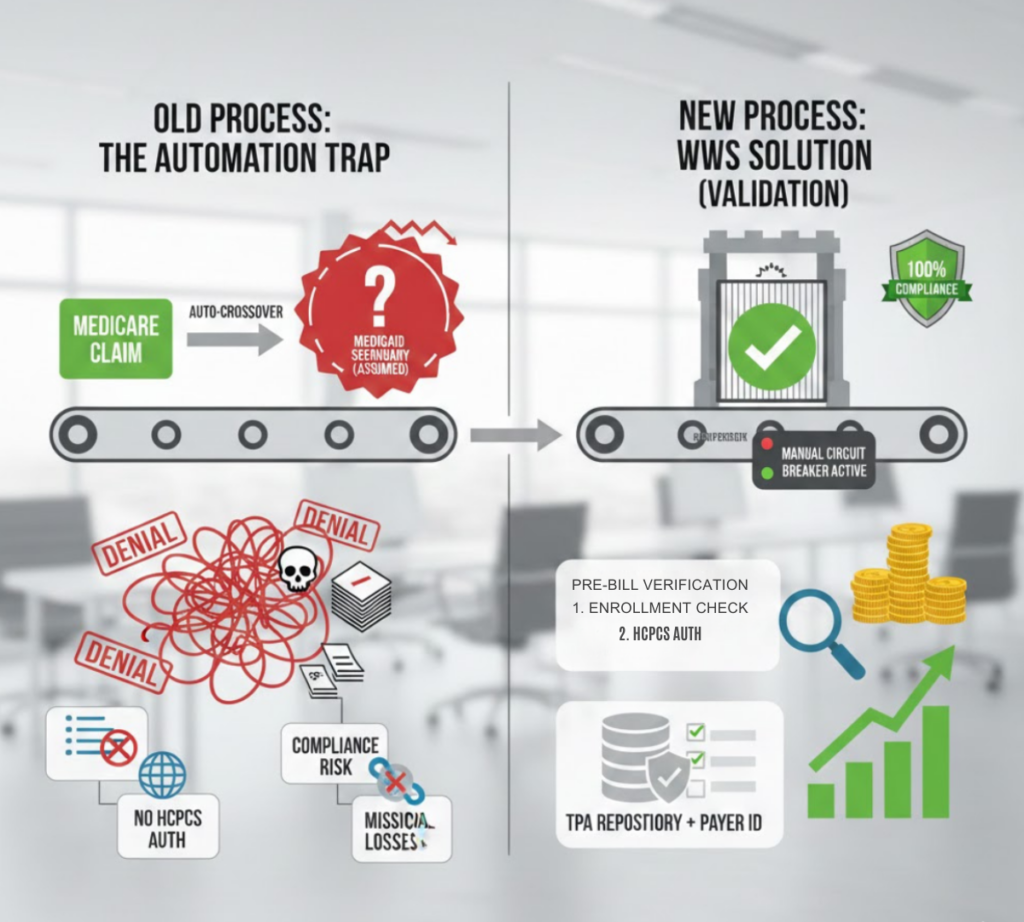
    Managing “Dual Eligible” patients—those with both Medicare and Medicaid coverage—is a staple of revenue cycle management. Typically, the process is automated: you bill Medicare, Medicare pays its portion, and the claim “crosses over” automatically to the state Medicaid plan for the balance.

    For the RCM team at our client organization, this was standard procedure. They saw “Medicaid Secondary” on the file and assumed the claim would be paid. They processed high volumes of crossover claims without a second thought, trusting the automation.

    Trusting the automation was a mistake. Our audit revealed a significant compliance blind spot regarding HCPCS Authorization.

    While the patient was enrolled in both plans, the RCM team was not verifying if the specific service codes (HCPCS) were actually authorized benefits under the secondary Medicaid plan. They were billing for services that Medicaid never agreed to cover.

    • The Risk: Submitting claims for unauthorized services is not just a denial risk; it is a compliance risk. It flags the provider for “abusive billing patterns”.
    • The TPA Blind Spot: The team also lacked a centralized repository for Third-Party Administrator (TPA) details, often missing the specific TPA ID required to process the secondary claim correctly.

    Because these claims were being submitted blindly, they generated a high volume of complex denials that required manual rework. Even worse, if a claim was paid in error, the provider faced the threat of future recoupment audits.

    WWS intervened by inserting a manual “circuit breaker” into the automated workflow. We updated the Master Payer Index (MPI) to include a Crossover Validation Protocol.

    We established a new rule: Before any Medicaid plan is marked “Active” for secondary billing in the MPI, the Provider Enrollment team must verify two distinct factors:

    • Enrollment: Is the provider enrolled for this specific service type?
    • Authorization: Are the specific HCPCS codes on the fee schedule authorized for this plan?.

    We expanded the MPI structure to include a dedicated section for TPA Details. This ensures that when a claim does cross over, it is routed to the correct TPA with the correct Payer ID, eliminating “Lost Claim” denials.

    Diagram of the WWS manual circuit breaker in crossover billing

    By moving from “Assumption” to “Validation,” we secured 100% compliance on dual-eligible billing for Q3. We transformed a passive, high-risk workflow into an active, verified revenue stream, protecting the provider from the “death by a thousand cuts” of small balance denials.

  • “Disqualified”: The Redetermination Appeal Process (Level 1)

    “Disqualified”: The Redetermination Appeal Process (Level 1)

    You fought the notice. You lost.

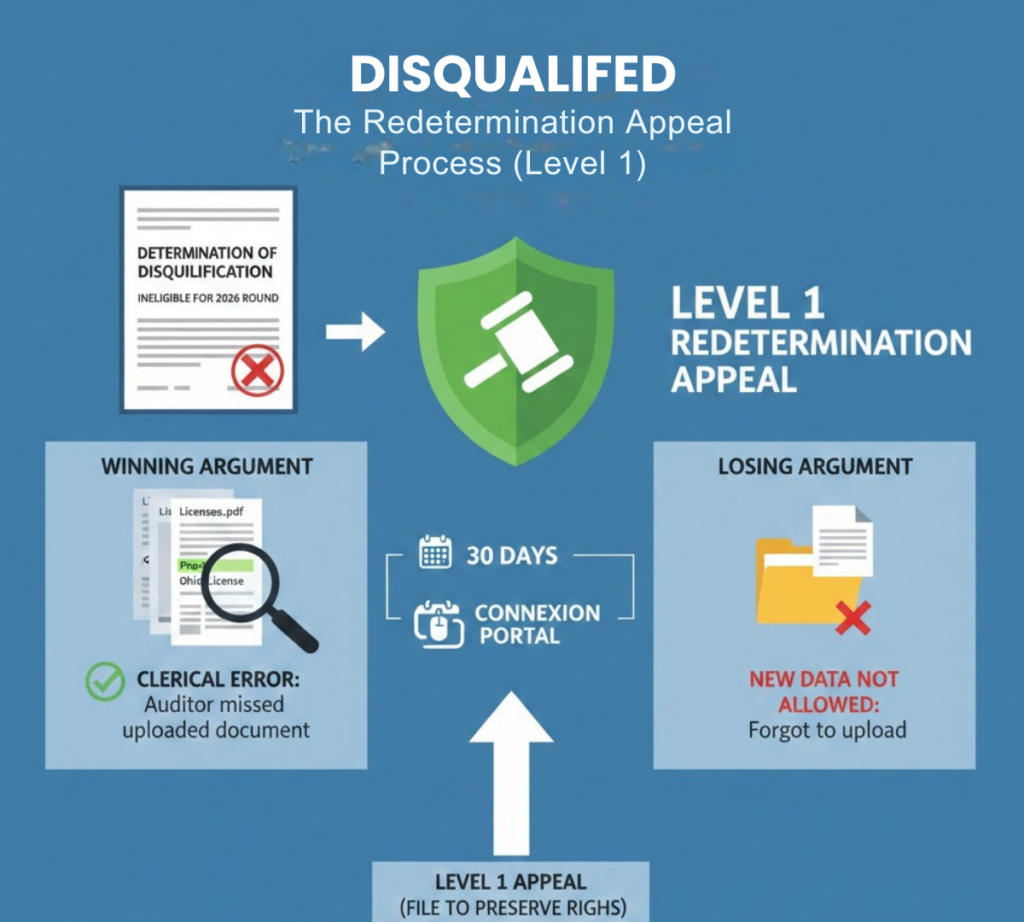
    Now you have the official Determination Letter. It says: “You are ineligible for the 2026 Round.”

    Most providers quit here.

    Do not quit.

    The auditors are human (or algorithms). They make mistakes. You have one last shot before the contracts are awarded: The Level 1 Appeal.

    • Window: You typically have 30 days from the date of the letter to file.
    • Method: Submitted via Connexion.

    Appeals are rarely won on “Mercy.” They are won on “Facts.”

    • Winning Argument: “The auditor stated we missed the Ohio license. We uploaded the Ohio license on Page 4 of the PDF named ‘Licenses.pdf’. The auditor overlooked this valid document. See screenshot.”
    • Losing Argument: “We forgot to upload the Ohio license, but here it is now.” (New data is not allowed).

    Even if you lose Level 1, filing it preserves your right to go to Level 2 (Reconsideration) and Level 3 (ALJ). If you skip Level 1, you waive all future rights. Always file.

    Infographic showing the 30-day appeal timeline and the "Clerical Error" vs. "New Data" logic

    Wonder Worth Solutions treats this like a court case. We draft the legal argument, cite the specific page numbers of your original bid, and compel the auditor to reverse the decision.

    Officially Disqualified?

  • The “Bona Fide” Bid Audit: When CMS Asks for Invoices

    The “Bona Fide” Bid Audit: When CMS Asks for Invoices

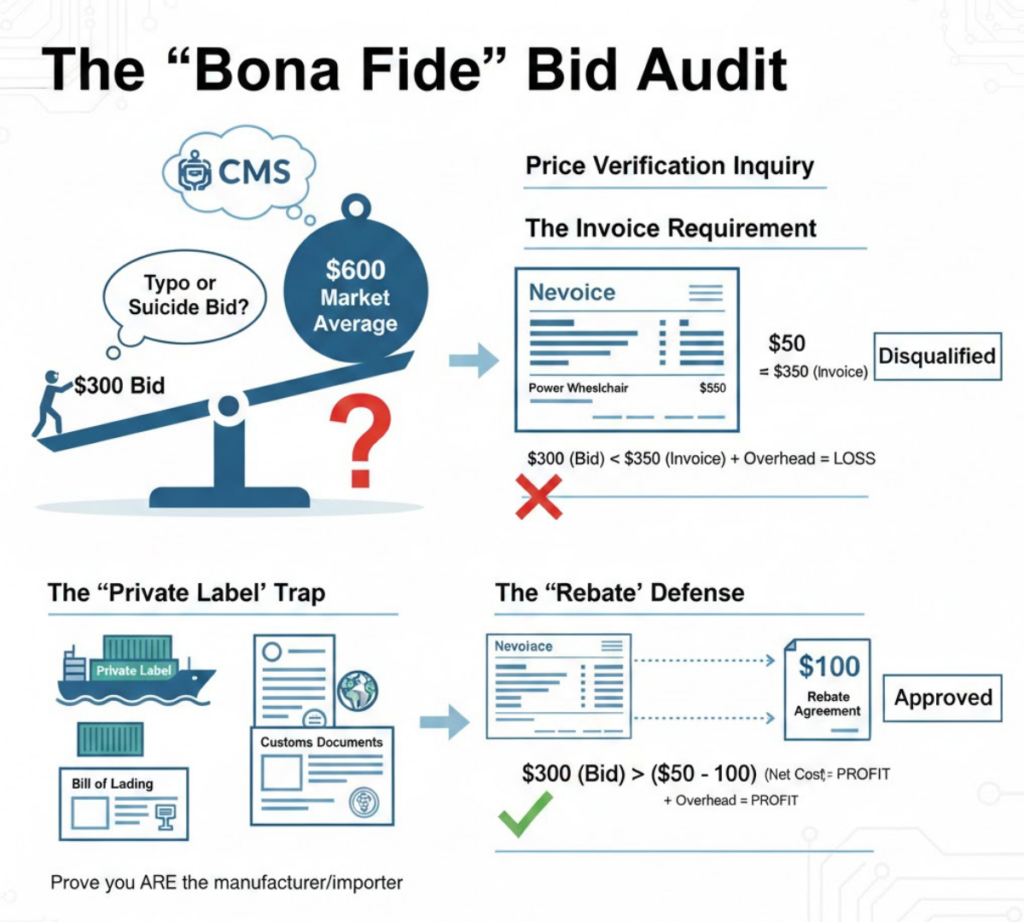
    You bid $300 for a standard power wheelchair.

    The market average is $600.

    CMS thinks you made a typo—or that you are trying to “suicide bid” to tank the market.

    You receive a “Price Verification Inquiry.”

    CMS wants to see an actual invoice from the last 6 months.

    • The Math: Bid Price > (Invoice Price + Overhead).
    • The Trap: If your invoice shows you buy the chair for $350, and you bid $300, you just proved you are bidding at a loss. Disqualified.

    What if the invoice says $350, but you get a $100 rebate at the end of the year?

    • The Strategy: You must upload the invoice AND the Rebate Contract.
    • The Narrative: “Although the invoice list price is $350, our volume rebate agreement (Attached) reduces the net effective cost to $250. Therefore, our bid of $300 is profitable.”
    • Scenario: You bid low because you import your own chairs from overseas.
    • The Proof: You must provide the “Bill of Lading” and “Customs Documents” to prove you are the manufacturer/importer and control the cost.
    Infographic showing the types of documentation required for a bona fide bid audit (Invoices, Quotes, Price Lists)

    Wonder Worth Solutions reviews your invoices before you upload them. We calculate the “Net Effective Cost” to ensure your response proves profitability, not bankruptcy.

    Asked to prove your price?

  • The “Financial Capacity” Audit: Responding to Form A Inquiries

    The “Financial Capacity” Audit: Responding to Form A Inquiries

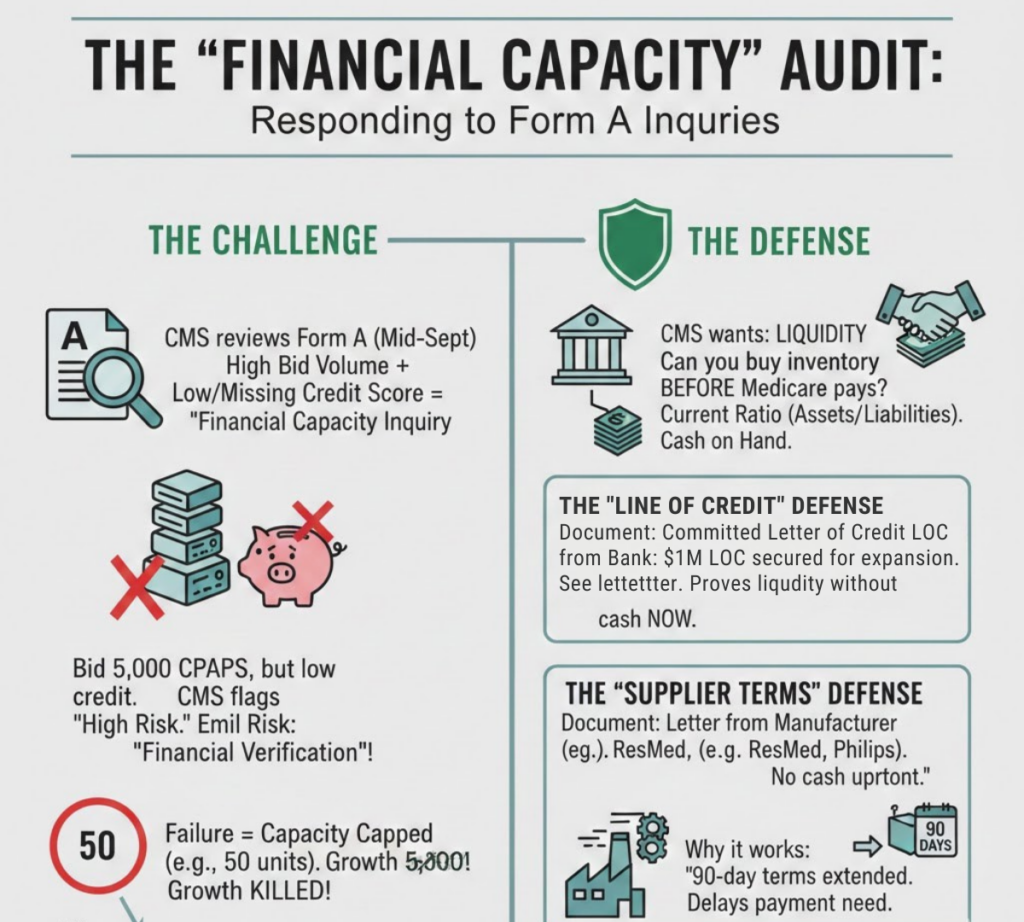
    You bid to supply 5,000 CPAP machines.

    CMS checked your credit report. It shows a small line of credit and a history of late payments.

    The algorithm flagged you: “High Risk of Contract Default.”

    Now, you have an email asking for “Financial Verification.”

    This is your chance to prove the algorithm wrong. If you fail this audit, CMS will cap your capacity at your historical level (e.g., 50 units), effectively killing your growth.

    They want to answer one question: Liquidity.

    Can you afford to buy the inventory before Medicare pays you?

    • The Ratio: They look for a healthy “Current Ratio” (Assets / Liabilities).
    • The Cash: They want to see cash on hand.

    The best way to answer this inquiry is with a letter from your bank.

    • The Document: A committed Letter of Credit (LOC).
    • The Narrative: “While our current cash is low, we have secured a $1M LOC specifically for this contract expansion. See attached bank letter.”
    • Why it works: It proves liquidity without requiring cash in the bank today.

    If you don’t have a bank loan, use your vendors.

    • The Document: A letter from your manufacturer (e.g., ResMed, Philips).
    • The Narrative: “Our supplier has extended us 90-day terms for the duration of this contract. We do not need cash upfront.”
    Diagram illustrating the relationship between financial ratios, credit scores, and the expansion threshold score

    Wonder Worth Solutions helps you gather the financial evidence. We work with your CFO or accountant to structure the response in a way that satisfies the CMS auditor’s liquidity concerns.

    Flagged for Financials?