

Answer Summary
DME providers can solve the data silo crisis by implementing a Master Payer Index (MPI) that serves as a single source of truth for both RCM and Enrollment teams, eliminating the 20% productivity loss caused by redundant queries. Transitioning to a centralized database is a critical operational move for 2026 to ensure 100% data accuracy for CMS compliance and interoperability standards. By mandating standardized naming conventions and monthly governance protocols, organizations can reduce inter-departmental friction and prevent the administrative errors that lead to lost revenue.
The Scenario: The “Left Hand, Right Hand” Problem
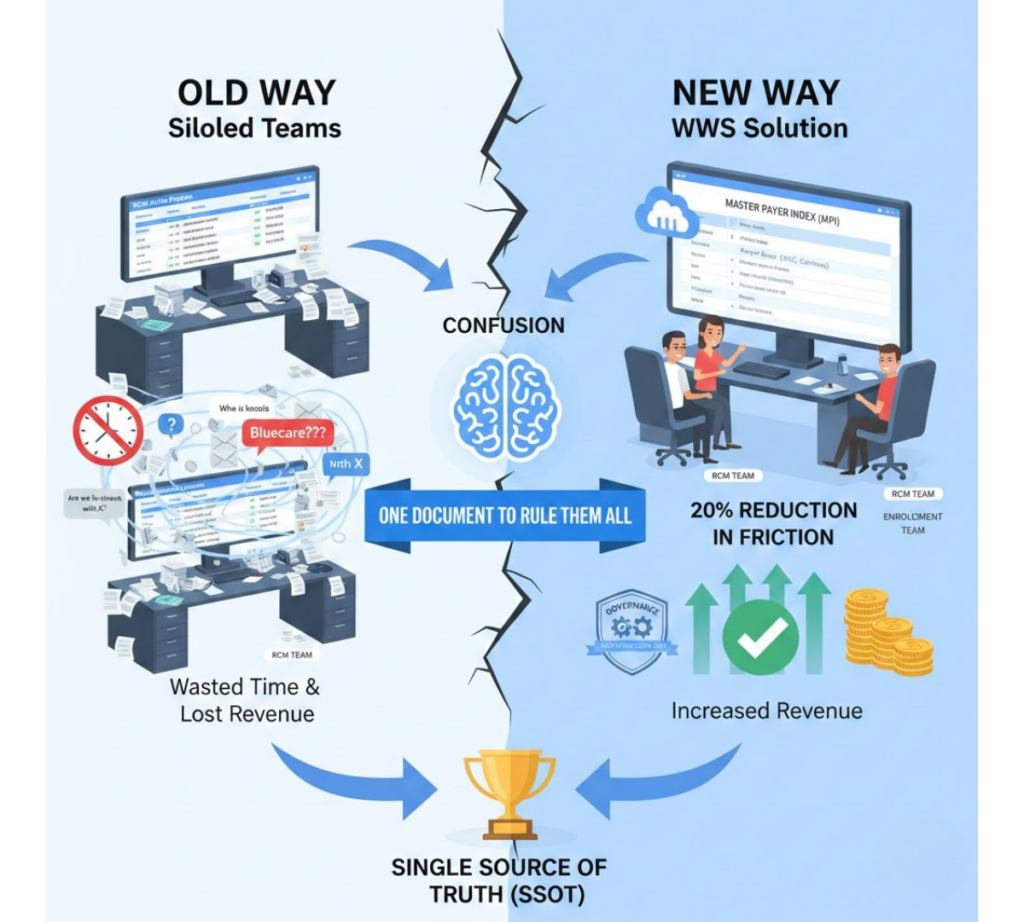
In many organizations, the RCM Team (Billing) and the Provider Enrollment Team (Contracting) exist in parallel universes. At our client organization, this separation was physical and digital. The RCM team had their own spreadsheet of “Active Payers.” The Enrollment team had a different list.
They didn’t talk. They didn’t sync. They just worked.
The Operational Failure
This “Information Silo” created a chaotic operational environment characterized by confusion and waste.
1. The Naming Game
The two teams used different naming conventions for the same entities. RCM listed a payer as “Bluecare,” while Enrollment listed it as “BCBS TN.”
- The Impact: This lack of standardized naming led to confusion and redundant work. Staff wasted time trying to figure out if they were talking about the same contract.
2. Redundant Queries
Because there was no single truth, the RCM team constantly emailed Enrollment: “Are we in-network with X?”
- The Data: Our analysis estimated that 20% of the team’s time was wasted on these duplicate, redundant queries—questions that could have been answered instantly if they shared a database.
The WWS Solution: The Master Payer Index (MPI)
WWS dismantled the silos by building the Master Payer Index (MPI) (formerly SSOT).
1. One Document to Rule Them All
We created a centralized, cloud-based repository that serves as the definitive reference for the entire organization.
- Mandatory Naming: We added a “Payer Alias” field that must be populated with all known names (e.g., “Absolute Total Care,” “ATC,” “Centene”) to eliminate ambiguity.
2. Governance Protocol
Technology alone doesn’t fix culture. We instituted a Governance Protocol requiring the Chapter Leaders of both the RCM and Enrollment teams to review and sign off on the MPI monthly. This forced alignment.
The Outcome
We achieved a 20% reduction in inter-departmental friction. By forcing the billing and contracting teams to look at the same “Truth,” we eliminated the “He said, She said” errors that lead to lost revenue.