Category: Healthcare credentialing

  • Mastering BATNA in Healthcare Credentialing and Contracting: Your Secret Weapon for Successful Negotiations

    Mastering BATNA in Healthcare Credentialing and Contracting: Your Secret Weapon for Successful Negotiations

    Introduction:

    In the high-stakes world of healthcare credentialing and contracting, entering negotiations without a clear understanding of your BATNA (Best Alternative to a Negotiated Agreement) is like sailing without a compass. As we navigate the complex healthcare landscape of 2024, mastering the concept of BATNA has become more crucial than ever. This comprehensive guide will explore how understanding and leveraging your BATNA can dramatically improve your negotiation outcomes in healthcare credentialing and contracting.

    What is BATNA?

    BATNA, or Best Alternative to a Negotiated Agreement, is a concept developed by negotiation experts Roger Fisher and William Ury. It represents your best course of action if current negotiations fail to reach an agreement. In essence, it’s your “Plan B” – the path you’ll take if you can’t strike a deal.

    Why BATNA Matters in Healthcare Credentialing and Contracting:

    1. Empowers Decision-Making:
      • Provides a clear benchmark against which to measure any proposed agreement
      • Helps avoid accepting unfavorable terms out of desperation
    2. Enhances Negotiation Confidence:
      • Knowing your alternatives boosts confidence at the negotiation table
      • Allows for more assertive positioning without fear of walking away empty-handed
    3. Improves Risk Assessment:
      • Enables better evaluation of the risks associated with not reaching an agreement
      • Helps in prioritizing which terms are truly essential versus merely desirable
    4. Increases Leverage:
      • A strong BATNA can significantly enhance your bargaining power
      • Can be used strategically to influence the other party’s perception and behavior

    Determining Your BATNA in Healthcare Negotiations:

    1. Identify All Possible Alternatives:
      • List all potential options if the current negotiation fails
      • Example: For hospital credentialing, alternatives might include:
        • Credentialing with competing healthcare systems
        • Focusing on private practice or telemedicine
        • Exploring locum tenens opportunities
    2. Evaluate Each Alternative:
      • Assess the pros and cons of each option
      • Consider factors like financial impact, career growth, and work-life balance
    3. Select the Best Alternative:
      • Choose the option that offers the most value or least downside
      • This becomes your BATNA – your fallback if negotiations fail
    4. Improve Your BATNA:
      • Look for ways to strengthen your best alternative
      • Example: Securing a tentative offer from another healthcare system

    Understanding Your Leverage Points:

    Leverage in negotiations comes from various sources. In healthcare credentialing and contracting, key leverage points might include:

    1. Unique Qualifications:
      • Specialized skills or certifications that are in high demand
      • A track record of excellent patient outcomes or high patient satisfaction scores
    2. Market Demand:
      • Shortages in your specialty area
      • Your ability to bring in patients or referrals
    3. Reputation and Network:
      • Strong professional reputation in the medical community
      • Extensive referral network or patient base
    4. Flexibility:
      • Willingness to work in underserved areas or take on less desirable shifts
      • Ability to offer telemedicine services
    5. Cost-Effectiveness:
      • Proven track record of efficient resource utilization
      • Ability to perform procedures that generate significant revenue

    Identifying Potential Concessions:

    While it’s important to know your leverage, understanding where you can make concessions is equally crucial:

    1. Prioritize Your Needs:
      • Distinguish between “must-haves” and “nice-to-haves”
      • Be prepared to concede on less critical points
    2. Consider Non-Monetary Concessions:
      • Flexible scheduling
      • Professional development opportunities
      • Leadership roles or committee positions
    3. Think Long-Term:
      • Be open to performance-based incentives or future review periods
      • Consider accepting lower initial terms with built-in increases over time
    4. Explore Creative Solutions:
      • Look for win-win scenarios that address both parties’ interests
      • Consider bundling multiple issues to create more value

    Strategies for Leveraging Your BATNA:

    1. Keep Your BATNA Private (Usually):
      • In most cases, it’s best not to reveal your BATNA
      • Exception: If your BATNA is exceptionally strong, hinting at it can increase your leverage
    2. Improve Your BATNA During Negotiations:
      • Continue exploring alternatives even as you negotiate
      • Any improvement in your BATNA strengthens your position
    3. Assess the Other Party’s BATNA:
      • Try to understand the alternatives available to the other party
      • This knowledge can help you gauge their flexibility and pressure points
    4. Use Your BATNA to Set Your Reservation Point:
      • Your BATNA helps determine the least favorable point at which you’d accept a deal
      • Never accept terms worse than your BATNA
    5. Be Prepared to Walk Away:
      • If the proposed agreement is worse than your BATNA, be ready to end negotiations
      • Walking away can sometimes bring the other party back with better terms

    Case Study: BATNA in Action

    Dr. Sarah Chen, a highly skilled neurosurgeon, was negotiating her contract renewal with Metropolitan Hospital. Her BATNA analysis revealed:

    • A standing offer from a competing hospital with slightly lower compensation but state-of-the-art facilities
    • The option to start her own practice, leveraging her excellent reputation
    • A telemedicine opportunity that offered flexibility but lower initial income

    Understanding these alternatives, Dr. Chen:

    1. Negotiated more confidently, knowing she had solid options
    2. Focused on securing access to advanced equipment, matching her BATNA’s offerings
    3. Obtained better terms by subtly hinting at interest from competitors
    4. Ultimately secured a 15% raise and commitment to facility upgrades

    Conclusion:

    In the complex world of healthcare credentialing and contracting, mastering your BATNA is not just a negotiation tactic – it’s a strategic imperative. By thoroughly understanding your alternatives, leverage points, and potential concessions, you position yourself for more favorable outcomes. Remember, the goal isn’t just to have a good BATNA, but to strategically use this knowledge to guide your negotiations.

    As healthcare continues to evolve, those who can effectively leverage their BATNA will find themselves in stronger positions, able to secure agreements that truly reflect their value and meet their professional needs.

    How WWS Can Help:

    At WWS, we understand the intricacies of healthcare negotiations and the critical role of BATNA. Our expert team and advanced analytics can help you:

    • Conduct comprehensive market analyses to identify and strengthen your BATNA
    • Provide data-driven insights into industry standards and compensation trends
    • Offer strategic guidance on leveraging your unique value propositions
    • Support you with tools and resources for effective negotiation planning

    Ready to strengthen your negotiation position with a solid BATNA strategy? Let’s start a conversation about how we can support your success.

    Schedule an introductory meeting with us today: https://calendly.com/wwshcs/wws-collaborative-discovery-meeting

    Together, we can enhance your negotiation power, improve your credentialing and contracting outcomes, and drive your healthcare career or organization towards greater success.

  • AI-Powered Credentialing: Revolutionizing Healthcare Administration in 2024

    AI-Powered Credentialing: Revolutionizing Healthcare Administration in 2024

    Introduction:

    As we navigate the complex landscape of healthcare administration in 2024, Artificial Intelligence (AI) has emerged as a transformative force, particularly in the realm of credentialing. The traditional, labor-intensive process of verifying and managing healthcare provider credentials is undergoing a radical transformation, thanks to the power of AI. This blog post explores how AI is reshaping credentialing processes, making them faster, more accurate, and infinitely more efficient than ever before.

    Understanding AI in Healthcare Credentialing:

    Before delving into its applications, let’s clarify what we mean by AI in the context of healthcare credentialing:

    Definition: AI in credentialing refers to the use of machine learning algorithms and advanced data processing techniques to automate and enhance the verification, analysis, and management of healthcare provider credentials.

    Key AI Technologies in Credentialing:

    1. Natural Language Processing (NLP): For interpreting and extracting information from unstructured credential documents.
    2. Machine Learning: For pattern recognition and predictive analytics in credential verification.
    3. Robotic Process Automation (RPA): For automating repetitive tasks in the credentialing workflow.
    4. Computer Vision: For analyzing and verifying visual elements of credentials, such as signatures or seals.

    The Transformative Benefits of AI-Powered Credentialing:

    1. Accelerated Verification Processes:
      • Automated data extraction from various credential sources
      • Rapid cross-referencing with multiple databases
      • Reduction in credentialing time from weeks to hours or even minutes
    2. Enhanced Accuracy:
      • Minimization of human errors in data entry and verification
      • Consistent application of credentialing criteria across all applications
      • Advanced pattern recognition for detecting inconsistencies or red flags
    3. Predictive Insights:
      • Anticipating credential expirations and proactively initiating renewals
      • Identifying potential issues in a provider’s history before they become problems
      • Suggesting optimal credentialing pathways based on provider specialties and organizational needs
    4. Cost Reduction:
      • Significant decrease in manual labor requirements
      • Reduction in credentialing-related administrative costs (up to 80% in some cases)
      • Faster turnaround times leading to quicker provider onboarding and revenue generation
    5. Improved Compliance:
      • Real-time monitoring of regulatory changes and automatic updates to credentialing criteria
      • Ensuring consistent adherence to accreditation standards
      • Generating comprehensive audit trails for regulatory inspections
    6. Enhanced Provider Experience:
      • Streamlined application processes with intuitive, AI-guided interfaces
      • Reduced documentation burden on healthcare providers
      • Faster time-to-practice, improving provider satisfaction

    Implementation Strategies for AI-Powered Credentialing:

    Adopting AI in credentialing is a significant undertaking. Here are key strategies for successful implementation:

    1. Assessing Organizational Readiness:
      • Evaluate current credentialing processes and identify pain points
      • Determine specific goals for AI implementation (e.g., reducing credentialing time, improving accuracy)
      • Assess existing technological infrastructure and data quality
    2. Choosing the Right AI Tools and Platforms:
      • Research AI credentialing solutions that align with organizational needs
      • Consider scalability, integration capabilities, and vendor support
      • Evaluate the AI’s ability to handle your organization’s specific credentialing requirements
    3. Data Preparation and Integration:
      • Clean and standardize existing credentialing data
      • Ensure interoperability between AI systems and existing databases
      • Implement robust data governance policies
    4. Phased Implementation:
      • Start with a pilot program in a specific department or for a particular provider type
      • Gradually expand AI implementation based on pilot results and lessons learned
      • Continuously refine AI models with feedback and new data
    5. Staff Training and Change Management:
      • Provide comprehensive training on new AI-powered systems
      • Address concerns about job displacement and emphasize AI as a tool to enhance human capabilities
      • Develop new roles focused on AI oversight and strategic credentialing management

    Overcoming Challenges in AI-Powered Credentialing:

    While the benefits are substantial, implementing AI in credentialing comes with its own set of challenges:

    1. Data Quality and Standardization:
      Challenge: Inconsistent or poor-quality data can lead to inaccurate AI outputs
      Solution: Implement data cleansing processes and establish standardized data entry protocols
    2. Privacy and Security Concerns:
      Challenge: Handling sensitive provider information requires robust security measures
      Solution: Employ advanced encryption, access controls, and compliance with regulations like HIPAA
    3. Integration with Legacy Systems:
      Challenge: Many healthcare organizations rely on outdated credentialing systems
      Solution: Develop APIs and middleware solutions for seamless integration, or consider phased system replacement
    4. Regulatory Compliance:
      Challenge: Ensuring AI systems adhere to ever-changing healthcare regulations
      Solution: Regular updates to AI algorithms and consultation with legal experts on compliance requirements
    5. Resistance to Change:
      Challenge: Staff may be hesitant to adopt new AI-powered systems
      Solution: Emphasize benefits, provide thorough training, and involve staff in the implementation process

    Case Studies: AI Credentialing Success Stories

    Several healthcare organizations have successfully implemented AI in their credentialing processes:

    Case Study 1: Metropolitan Health Network

    • Implemented AI-powered credentialing in early 2023
    • Reduced average credentialing time from 60 days to 5 days
    • Achieved 99.8% accuracy in credential verification
    • Realized annual cost savings of $2.5 million

    Case Study 2: National Telehealth Provider

    • Adopted AI for credentialing across multiple state jurisdictions
    • Onboarded 10,000+ providers in 3 months (previously would have taken 1+ year)
    • Reduced credentialing-related provider queries by 90%
    • Improved provider satisfaction scores from 65% to 92%

    The Future of AI in Healthcare Credentialing:

    As we look beyond 2024, the potential for AI in healthcare credentialing continues to expand:

    1. Advanced Predictive Analytics: AI systems will not only verify credentials but predict future performance and potential issues.
    2. Seamless Global Credentialing: AI will facilitate near-instantaneous credentialing across international healthcare systems.
    3. AI-Driven Continuous Monitoring: Real-time tracking of provider status, including immediate flagging of adverse actions or license issues.
    4. Integration with Blockchain: Combining AI’s analytical power with blockchain’s security for unparalleled credential management.
    5. Personalized Credentialing Pathways: AI systems creating custom credentialing processes based on individual provider profiles and organizational needs.

    Conclusion: Embracing the AI Revolution in Healthcare Credentialing

    The integration of AI into healthcare credentialing represents a quantum leap in how we approach this critical administrative function. By dramatically improving speed, accuracy, and efficiency, AI-powered credentialing not only streamlines operations but also contributes to better patient care through more thorough and timely provider vetting.

    As we continue through 2024 and beyond, healthcare organizations that embrace AI in their credentialing processes will find themselves at a significant advantage. The question is no longer whether to adopt AI in credentialing, but how quickly and effectively organizations can implement this game-changing technology.

    How WWS Can Help:

    At WW Scribe Healthcare Solutions, we’re at the forefront of AI-powered credentialing innovation. Our state-of-the-art platform harnesses the power of AI to revolutionize your credentialing processes. We offer:

    • Customized AI credentialing solutions tailored to your organization’s unique needs
    • Seamless integration with your existing systems and workflows
    • Comprehensive training and ongoing support to ensure successful adoption
    • Continuous updates and enhancements to keep you ahead of the curve in credentialing technology

    Ready to transform your credentialing process with the power of AI? Let’s start the conversation.

    Schedule an introductory meeting with us today: https://calendly.com/wwshcs/wws-collaborative-discovery-meeting

    Together, we can build a more efficient, accurate, and forward-thinking healthcare credentialing system for the future.

  • Streamlining the CAQH ProView Process for DME Providers: A Comprehensive Guide

    Streamlining the CAQH ProView Process for DME Providers: A Comprehensive Guide

    As a Durable Medical Equipment (DME) provider, efficient credentialing is crucial for your business operations. CAQH ProView has become an essential tool in this process, serving as a centralized repository for your professional and practice information. This guide will walk you through the CAQH ProView process, offering tips to streamline your experience and maintain compliance.

    Understanding CAQH ProView for DME Providers

    CAQH ProView is a free, online service that simplifies the credentialing process by allowing healthcare providers to submit their information to a single database. For DME providers, this platform is particularly valuable as it:

    1. Reduces administrative burden by eliminating the need to submit the same information to multiple payers
    2. Ensures data consistency across all participating organizations
    3. Facilitates faster credentialing processes, potentially leading to quicker reimbursements
    4. Allows for easy updates and re-attestation of your information

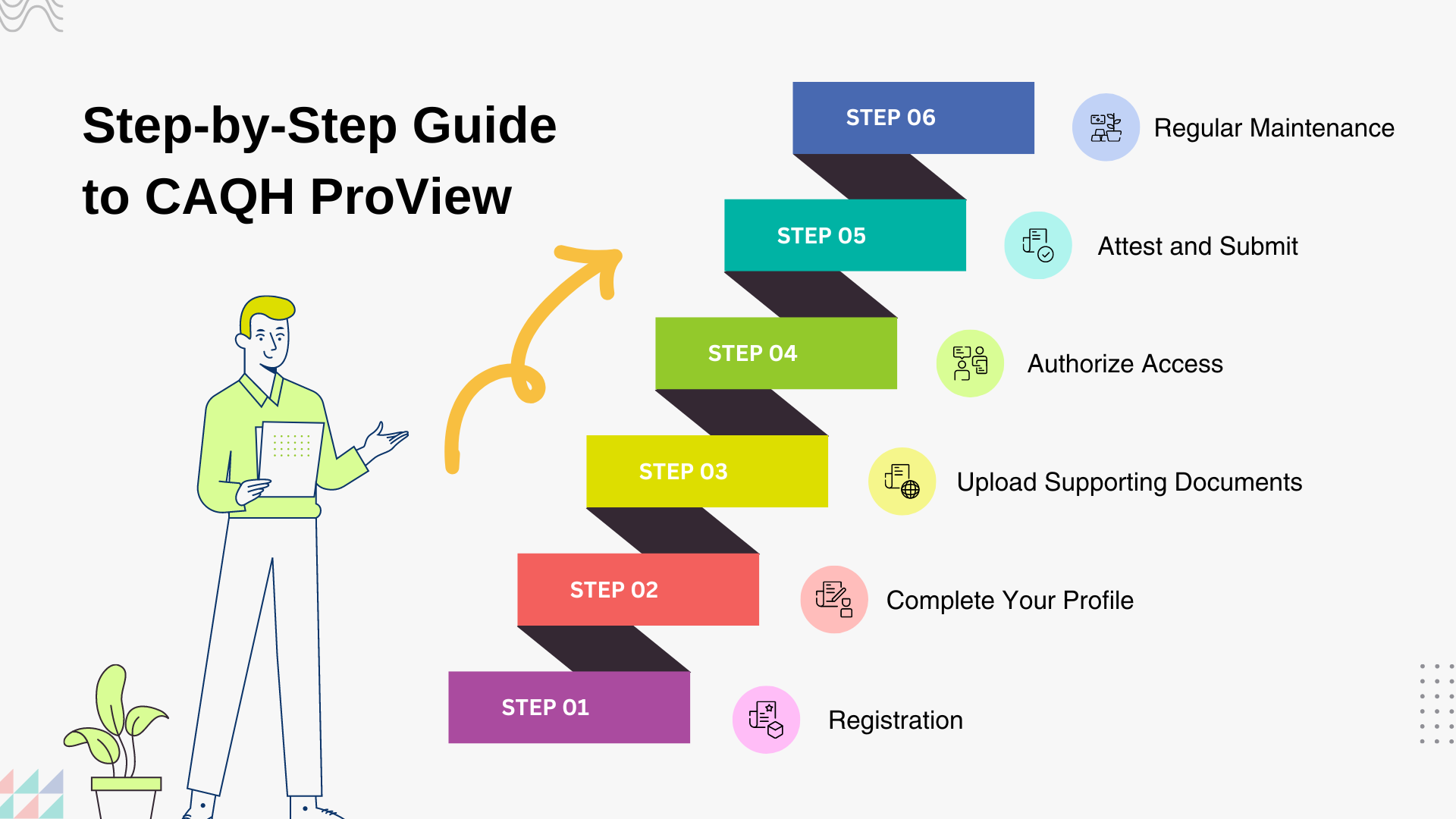
    Step-by-Step Guide to CAQH ProView

    CAQH Proview Steps

    1. Registration
    – Visit proview.caqh.org and click “Register”
    – Select “Provider” as your registration type
    – Enter your personal information, including your NPI number

    2. Complete Your Profile
    – Personal Information: Enter basic details like name, date of birth, and contact information
    – Professional IDs: Include your NPI, Medicare/Medicaid numbers, and any relevant DME-specific certifications
    – Education and Training: Although less relevant for DME providers, include any specialized training or certifications
    – Professional and Practice Information:
    – Specify your role as a DME provider
    – List all practice locations and contact details
    – Include information about your DME product lines
    – Credentialing Contact: Designate a point person for credentialing-related queries
    – Disclosure and Malpractice History: Answer all questions honestly and thoroughly

    3. Upload Supporting Documents
    – Business licenses
    – Liability insurance certificates
    – Accreditation documents (e.g., ACHC, JCAHO)
    – Any product-specific certifications

    4. Authorize Access
    – Select which participating organizations can access your information
    – For DME providers, this typically includes major insurance companies and Medicare/Medicaid

    5. Attest and Submit
    – Review all entered information for accuracy
    – Complete the attestation process to confirm the truthfulness of your submission

    6. Regular Maintenance
    – Set reminders to re-attest every 120 days
    – Update your profile promptly when any information changes

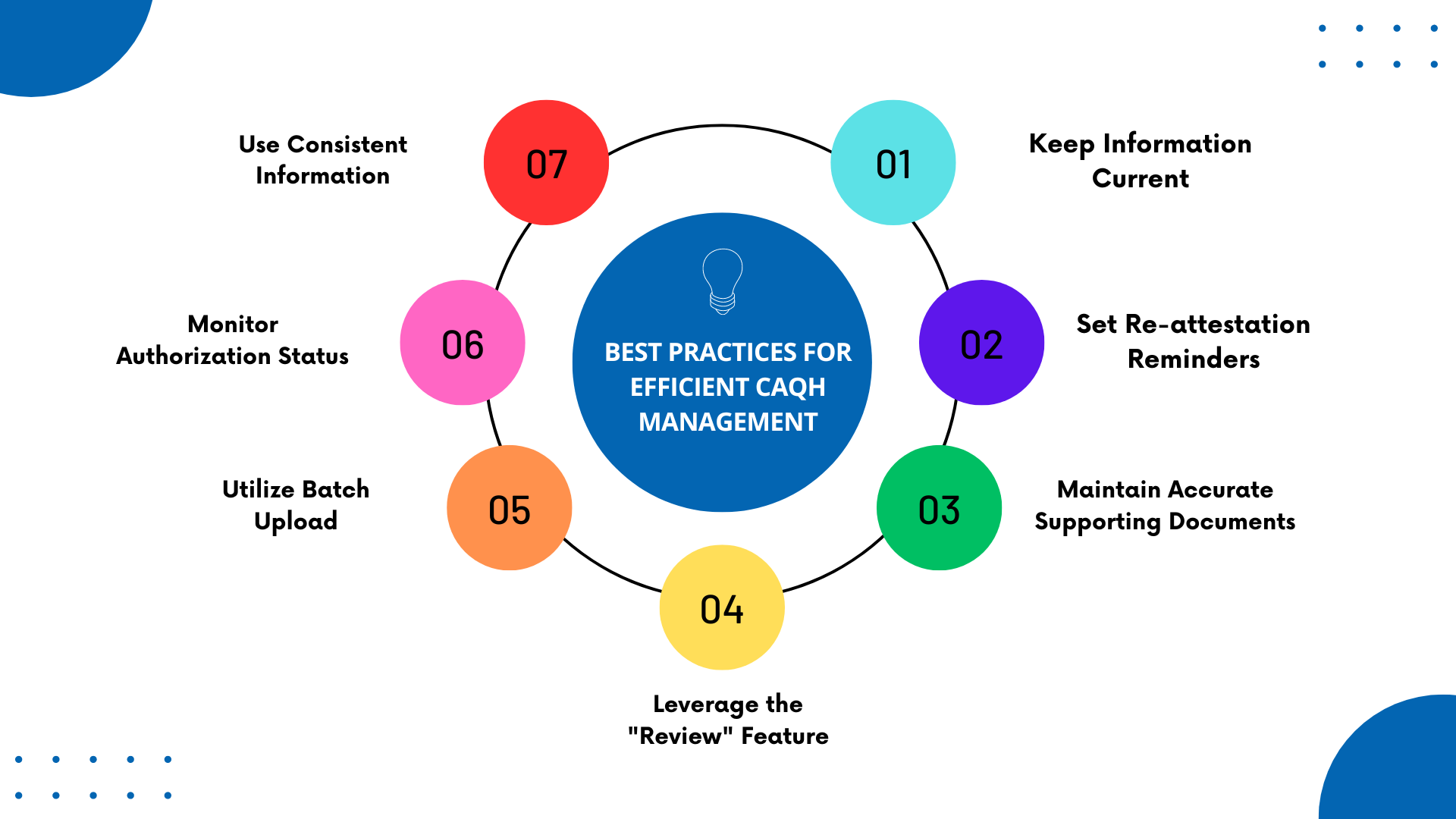
    Best Practices for Efficient CAQH Management

    CAQH Management

    1. Keep Information Current: Regularly update your profile to reflect any changes in your DME business, product lines, or certifications
    2. Set Re-attestation Reminders: Mark your calendar or set digital reminders for the 120-day re-attestation requirement
    3. Maintain Accurate Supporting Documents: Ensure all uploaded documents are current and legible
    4. Leverage the “Review” Feature: Before submitting, use the review option to catch any errors or inconsistencies
    5. Utilize Batch Upload: If you have multiple documents, use the batch upload feature to save time
    6. Monitor Authorization Status: Regularly check which organizations have access to your information and update as needed
    7. Use Consistent Information: Ensure the data in CAQH ProView matches what you provide in other credentialing applications

    How WWS Enhances Your CAQH ProView Experience

    At WWS, we understand the critical role CAQH ProView plays in your DME business operations. Our comprehensive support includes:

    – Profile Management: We help you set up and maintain your CAQH ProView profile, ensuring all information is accurate and up-to-date
    – Document Tracking: Our system keeps track of your document expiration dates, alerting you when updates are needed
    – Re-attestation Reminders: We provide timely reminders for your 120-day re-attestation requirement
    – Data Consistency Checks: We cross-reference your CAQH data with other credentialing applications to ensure consistency
    – Troubleshooting Support: Our experts are available to help resolve any issues or answer questions about the CAQH ProView process
    – Integration with Credentialing Workflow: We seamlessly integrate CAQH ProView management into your overall credentialing strategy

    By partnering with WWS, you can transform CAQH ProView from a necessary task into a strategic tool for streamlining your credentialing process. Our support allows you to focus on what you do best – providing quality DME products and services to your patients.

    Remember, an efficiently managed CAQH ProView profile is more than just a compliance requirement; it’s a gateway to faster credentialing, quicker contracting, and ultimately, improved cash flow for your DME business.

    References and Further Reading:

    1. CAQH ProView Official Website: https://proview.caqh.org
    2. National Provider Identifier (NPI) Registry: https://npiregistry.cms.hhs.gov/