Category: AI Integration

  • Blockchain and Credentialing: Securing the Future of Healthcare Data in 2024

    Blockchain and Credentialing: Securing the Future of Healthcare Data in 2024

    Introduction:

    In the rapidly evolving landscape of healthcare technology, blockchain has emerged as a game-changing force, particularly in the realm of credentialing. As we navigate through 2024, the integration of blockchain into healthcare credentialing systems is not just a futuristic concept—it’s a present reality reshaping how we manage, verify, and secure healthcare provider information. This blog post delves into the transformative impact of blockchain on healthcare credentialing, exploring its benefits, challenges, and the promise it holds for a more secure and efficient healthcare ecosystem.

    Understanding Blockchain in Healthcare Credentialing:

    Before we dive into its applications, let’s demystify blockchain technology in the context of healthcare credentialing:

    Definition: At its core, blockchain is a decentralized, digital ledger that records transactions across multiple computers. In healthcare credentialing, these “transactions” are entries or updates to a provider’s credentials.

    Key Features:

    1. Immutability: Once data is recorded on the blockchain, it cannot be altered without consensus from the network, ensuring the integrity of credential information.
    2. Transparency: All participants in the network can view the entire history of a credential, promoting trust and accountability.
    3. Decentralization: No single entity controls the data, reducing the risk of data manipulation or loss.
    4. Smart Contracts: Automated, self-executing contracts that can streamline verification processes and enforce credentialing rules.

    How Blockchain Applies to Healthcare Credentialing:

    • Creating a tamper-proof record of healthcare provider credentials
    • Enabling real-time verification of qualifications
    • Facilitating secure sharing of credential information across healthcare systems
    • Automating credential updates and renewals through smart contracts

    The Revolutionary Benefits of Blockchain in Credentialing:

    1. Enhanced Data Security:
      • Cryptographic protection against unauthorized alterations
      • Elimination of single points of failure in data storage
      • Reduction in fraudulent credentials through transparent tracking
    2. Improved Efficiency:
      • Streamlined verification processes, reducing credentialing time from weeks to minutes
      • Automated cross-checking of credentials against multiple sources
      • Reduction in administrative burden and associated costs
    3. Real-time Updates and Continuous Validation:
      • Instant reflection of credential changes across the network
      • Continuous monitoring of provider qualifications
      • Automated alerts for expiring credentials or disciplinary actions
    4. Interoperability and Standardization:
      • Seamless sharing of credentialing information across institutions
      • Creation of a universal, standardized format for credential data
      • Facilitation of multi-state licensing and credentialing
    5. Empowering Healthcare Providers:
      • Giving providers more control over their credential information
      • Simplifying the process of sharing credentials with multiple institutions
      • Reducing the need for repetitive submission of credential documentation
    6. Enhancing Patient Trust:
      • Providing a verifiable, transparent record of provider qualifications
      • Enabling patients to easily confirm the credentials of their healthcare providers
      • Improving overall trust in the healthcare system

    Implementation Challenges and Solutions:

    While the potential of blockchain in healthcare credentialing is immense, its implementation comes with certain challenges:

    1. Initial Costs and Infrastructure Requirements:
      Challenge: High upfront investment in blockchain technology and infrastructure
      Solution: Phased implementation approach, starting with pilot programs to demonstrate ROI
    2. Regulatory Compliance and Data Privacy:
      Challenge: Ensuring blockchain systems comply with HIPAA and other healthcare regulations
      Solution: Developing blockchain platforms specifically designed for healthcare, with built-in compliance features
    3. Industry-wide Adoption and Standardization:
      Challenge: Achieving consensus on blockchain standards across the healthcare industry
      Solution: Collaboration with healthcare governing bodies to establish industry-wide blockchain protocols
    4. Integration with Legacy Systems:
      Challenge: Connecting blockchain platforms with existing credentialing databases and software
      Solution: Developing robust APIs and middleware to facilitate seamless integration
    5. Education and Training:
      Challenge: Ensuring healthcare administrators and providers understand and trust blockchain technology
      Solution: Comprehensive training programs and clear communication about the benefits and security of blockchain

    Case Studies: Blockchain in Action

    Several healthcare organizations have already begun implementing blockchain for credentialing, with promising results:

    Case Study 1: National Health Network

    • Implemented a blockchain-based credentialing system in early 2023
    • Reduced credentialing processing time by 80%
    • Achieved 99.9% accuracy in credential verification
    • Saved $3 million annually in administrative costs

    Case Study 2: Multi-State Hospital Consortium

    • Adopted a blockchain platform for sharing provider credentials across 5 states
    • Reduced duplicate credentialing processes by 70%
    • Improved provider satisfaction scores by 45%
    • Facilitated rapid deployment of healthcare providers during emergency situations

    The Future of Blockchain in Healthcare Credentialing:

    As we look beyond 2024, the potential applications of blockchain in healthcare credentialing continue to expand:

    1. Global Credential Portability: International blockchain networks enabling seamless verification of credentials across borders.
    2. Integration with AI and Machine Learning: Predictive analytics for credential management and fraud detection.
    3. Patient-Controlled Health Records: Extending blockchain beyond provider credentials to include comprehensive, patient-controlled health records.
    4. Automated Compliance Management: Smart contracts automatically ensuring ongoing compliance with changing healthcare regulations.
    5. Blockchain-Enabled Telemedicine Credentialing: Facilitating rapid, secure credentialing for telemedicine providers across multiple jurisdictions.

    Conclusion: Embracing the Blockchain Revolution in Healthcare Credentialing

    The integration of blockchain technology into healthcare credentialing represents a paradigm shift in how we manage and verify healthcare provider information. By offering unprecedented levels of security, efficiency, and transparency, blockchain has the potential to solve many of the longstanding challenges in the credentialing process.

    As we continue through 2024 and beyond, healthcare organizations that embrace blockchain technology will find themselves at the forefront of a more secure, efficient, and patient-centric healthcare system. The question is no longer whether blockchain will transform healthcare credentialing, but how quickly organizations will adapt to this new reality.

    How WWS Can Help:

    At WWS, we’re leading the charge in blockchain-enabled credentialing solutions. Our cutting-edge platform leverages the power of blockchain to revolutionize your credentialing processes. We offer:

    • Customized blockchain credentialing solutions tailored to your organization’s specific needs
    • Seamless integration with existing systems and databases
    • Comprehensive training and support to ensure smooth adoption
    • Ongoing updates and enhancements to keep you at the forefront of credentialing technology

    Ready to secure your healthcare data and streamline your credentialing processes with blockchain technology? Let’s start the conversation.

    Schedule an introductory meeting with us today: https://calendly.com/wwshcs/wws-collaborative-discovery-meeting

    Together, we can build a more secure, efficient, and trustworthy healthcare credentialing system for the future.
  • AI-Powered Credentialing: Revolutionizing Healthcare Administration in 2024

    AI-Powered Credentialing: Revolutionizing Healthcare Administration in 2024

    Introduction:

    As we navigate the complex landscape of healthcare administration in 2024, Artificial Intelligence (AI) has emerged as a transformative force, particularly in the realm of credentialing. The traditional, labor-intensive process of verifying and managing healthcare provider credentials is undergoing a radical transformation, thanks to the power of AI. This blog post explores how AI is reshaping credentialing processes, making them faster, more accurate, and infinitely more efficient than ever before.

    Understanding AI in Healthcare Credentialing:

    Before delving into its applications, let’s clarify what we mean by AI in the context of healthcare credentialing:

    Definition: AI in credentialing refers to the use of machine learning algorithms and advanced data processing techniques to automate and enhance the verification, analysis, and management of healthcare provider credentials.

    Key AI Technologies in Credentialing:

    1. Natural Language Processing (NLP): For interpreting and extracting information from unstructured credential documents.
    2. Machine Learning: For pattern recognition and predictive analytics in credential verification.
    3. Robotic Process Automation (RPA): For automating repetitive tasks in the credentialing workflow.
    4. Computer Vision: For analyzing and verifying visual elements of credentials, such as signatures or seals.

    The Transformative Benefits of AI-Powered Credentialing:

    1. Accelerated Verification Processes:
      • Automated data extraction from various credential sources
      • Rapid cross-referencing with multiple databases
      • Reduction in credentialing time from weeks to hours or even minutes
    2. Enhanced Accuracy:
      • Minimization of human errors in data entry and verification
      • Consistent application of credentialing criteria across all applications
      • Advanced pattern recognition for detecting inconsistencies or red flags
    3. Predictive Insights:
      • Anticipating credential expirations and proactively initiating renewals
      • Identifying potential issues in a provider’s history before they become problems
      • Suggesting optimal credentialing pathways based on provider specialties and organizational needs
    4. Cost Reduction:
      • Significant decrease in manual labor requirements
      • Reduction in credentialing-related administrative costs (up to 80% in some cases)
      • Faster turnaround times leading to quicker provider onboarding and revenue generation
    5. Improved Compliance:
      • Real-time monitoring of regulatory changes and automatic updates to credentialing criteria
      • Ensuring consistent adherence to accreditation standards
      • Generating comprehensive audit trails for regulatory inspections
    6. Enhanced Provider Experience:
      • Streamlined application processes with intuitive, AI-guided interfaces
      • Reduced documentation burden on healthcare providers
      • Faster time-to-practice, improving provider satisfaction

    Implementation Strategies for AI-Powered Credentialing:

    Adopting AI in credentialing is a significant undertaking. Here are key strategies for successful implementation:

    1. Assessing Organizational Readiness:
      • Evaluate current credentialing processes and identify pain points
      • Determine specific goals for AI implementation (e.g., reducing credentialing time, improving accuracy)
      • Assess existing technological infrastructure and data quality
    2. Choosing the Right AI Tools and Platforms:
      • Research AI credentialing solutions that align with organizational needs
      • Consider scalability, integration capabilities, and vendor support
      • Evaluate the AI’s ability to handle your organization’s specific credentialing requirements
    3. Data Preparation and Integration:
      • Clean and standardize existing credentialing data
      • Ensure interoperability between AI systems and existing databases
      • Implement robust data governance policies
    4. Phased Implementation:
      • Start with a pilot program in a specific department or for a particular provider type
      • Gradually expand AI implementation based on pilot results and lessons learned
      • Continuously refine AI models with feedback and new data
    5. Staff Training and Change Management:
      • Provide comprehensive training on new AI-powered systems
      • Address concerns about job displacement and emphasize AI as a tool to enhance human capabilities
      • Develop new roles focused on AI oversight and strategic credentialing management

    Overcoming Challenges in AI-Powered Credentialing:

    While the benefits are substantial, implementing AI in credentialing comes with its own set of challenges:

    1. Data Quality and Standardization:
      Challenge: Inconsistent or poor-quality data can lead to inaccurate AI outputs
      Solution: Implement data cleansing processes and establish standardized data entry protocols
    2. Privacy and Security Concerns:
      Challenge: Handling sensitive provider information requires robust security measures
      Solution: Employ advanced encryption, access controls, and compliance with regulations like HIPAA
    3. Integration with Legacy Systems:
      Challenge: Many healthcare organizations rely on outdated credentialing systems
      Solution: Develop APIs and middleware solutions for seamless integration, or consider phased system replacement
    4. Regulatory Compliance:
      Challenge: Ensuring AI systems adhere to ever-changing healthcare regulations
      Solution: Regular updates to AI algorithms and consultation with legal experts on compliance requirements
    5. Resistance to Change:
      Challenge: Staff may be hesitant to adopt new AI-powered systems
      Solution: Emphasize benefits, provide thorough training, and involve staff in the implementation process

    Case Studies: AI Credentialing Success Stories

    Several healthcare organizations have successfully implemented AI in their credentialing processes:

    Case Study 1: Metropolitan Health Network

    • Implemented AI-powered credentialing in early 2023
    • Reduced average credentialing time from 60 days to 5 days
    • Achieved 99.8% accuracy in credential verification
    • Realized annual cost savings of $2.5 million

    Case Study 2: National Telehealth Provider

    • Adopted AI for credentialing across multiple state jurisdictions
    • Onboarded 10,000+ providers in 3 months (previously would have taken 1+ year)
    • Reduced credentialing-related provider queries by 90%
    • Improved provider satisfaction scores from 65% to 92%

    The Future of AI in Healthcare Credentialing:

    As we look beyond 2024, the potential for AI in healthcare credentialing continues to expand:

    1. Advanced Predictive Analytics: AI systems will not only verify credentials but predict future performance and potential issues.
    2. Seamless Global Credentialing: AI will facilitate near-instantaneous credentialing across international healthcare systems.
    3. AI-Driven Continuous Monitoring: Real-time tracking of provider status, including immediate flagging of adverse actions or license issues.
    4. Integration with Blockchain: Combining AI’s analytical power with blockchain’s security for unparalleled credential management.
    5. Personalized Credentialing Pathways: AI systems creating custom credentialing processes based on individual provider profiles and organizational needs.

    Conclusion: Embracing the AI Revolution in Healthcare Credentialing

    The integration of AI into healthcare credentialing represents a quantum leap in how we approach this critical administrative function. By dramatically improving speed, accuracy, and efficiency, AI-powered credentialing not only streamlines operations but also contributes to better patient care through more thorough and timely provider vetting.

    As we continue through 2024 and beyond, healthcare organizations that embrace AI in their credentialing processes will find themselves at a significant advantage. The question is no longer whether to adopt AI in credentialing, but how quickly and effectively organizations can implement this game-changing technology.

    How WWS Can Help:

    At WW Scribe Healthcare Solutions, we’re at the forefront of AI-powered credentialing innovation. Our state-of-the-art platform harnesses the power of AI to revolutionize your credentialing processes. We offer:

    • Customized AI credentialing solutions tailored to your organization’s unique needs
    • Seamless integration with your existing systems and workflows
    • Comprehensive training and ongoing support to ensure successful adoption
    • Continuous updates and enhancements to keep you ahead of the curve in credentialing technology

    Ready to transform your credentialing process with the power of AI? Let’s start the conversation.

    Schedule an introductory meeting with us today: https://calendly.com/wwshcs/wws-collaborative-discovery-meeting

    Together, we can build a more efficient, accurate, and forward-thinking healthcare credentialing system for the future.
  • Emerging Trends in DME Credentialing: AI and Blockchain Integration

    Emerging Trends in DME Credentialing: AI and Blockchain Integration

    Introduction:

    The Durable Medical Equipment (DME) industry is on the cusp of a technological revolution, particularly in the realm of credentialing. As we navigate through 2024, two groundbreaking technologies are at the forefront of this transformation: Artificial Intelligence (AI) and blockchain. These innovations promise to streamline processes, enhance security, and fundamentally change how DME providers approach credentialing. In this blog post, we’ll explore the current applications, benefits, challenges, and future potential of AI and blockchain in DME credentialing.

    The Technological Revolution in DME Credentialing

    The traditional DME credentialing process has long been characterized by time-consuming paperwork, manual verifications, and potential for human error. However, the integration of AI and blockchain is rapidly changing this landscape:

    • AI is automating repetitive tasks, improving accuracy, and accelerating the credentialing timeline.
    • Blockchain is enhancing data security, improving transparency, and creating immutable records of credentials.

    These technologies are not just incremental improvements; they represent a paradigm shift in how the industry approaches credentialing.

    Artificial Intelligence in Credentialing: Current Applications

    AI is already making significant inroads in DME credentialing. Here are some key applications:

    1. Document Verification:
      • AI-powered Optical Character Recognition (OCR) can quickly scan and extract information from credentials, licenses, and certifications.
      • Machine learning algorithms can verify the authenticity of documents by comparing them against known templates and patterns.
    2. Continuous Monitoring:
      • AI systems can continuously monitor regulatory databases, alerting providers to any changes that might affect their credentialing status.
      • Predictive analytics can forecast when renewals or updates will be needed, allowing for proactive management of credentials.
    3. Application Processing:
      • Natural Language Processing (NLP) can review and categorize credentialing applications, flagging potential issues for human review.
      • AI can automate the routing of applications to appropriate reviewers based on speciality or complexity.
    4. Data Aggregation and Analysis:
      • AI can quickly compile and analyze data from multiple sources, providing a comprehensive view of a provider’s qualifications.
      • Machine learning algorithms can identify patterns and trends in credentialing data, potentially uncovering insights for process improvement.

    Blockchain Technology: Ensuring Data Integrity and Security

    Blockchain technology is bringing unprecedented levels of security and transparency to DME credentialing:

    1. Immutable Record-Keeping:
      • Once recorded on a blockchain, credentialing information cannot be altered without leaving a clear audit trail.
      • This immutability reduces the risk of fraud and ensures the integrity of credentialing data.
    2. Decentralized Verification:
      • Blockchain allows for decentralized verification of credentials, potentially reducing the need for repetitive primary source verifications.
      • Payers and regulatory bodies can access a single, trusted source of credentialing information.
    3. Smart Contracts:
      • Blockchain-based smart contracts can automate certain aspects of the credentialing process, such as triggering renewals or updates when specific conditions are met.
    4. Enhanced Data Sharing:
      • With appropriate permissions, blockchain can facilitate secure sharing of credentialing information across different healthcare organizations and payers.

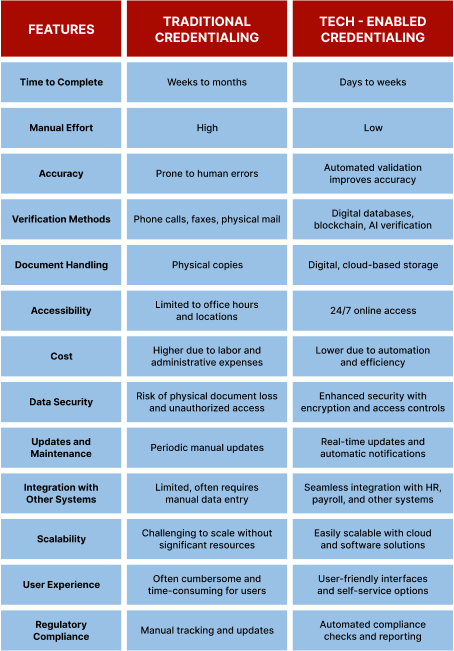
    Traditional vs Tech-enabled

    Benefits and Challenges of AI and Blockchain Adoption

    Benefits:

    • Increased Efficiency: Dramatically reduced processing times for credentialing applications.
    • Improved Accuracy: Reduction in errors associated with manual data entry and verification.
    • Enhanced Security: Better protection against fraud and unauthorized alterations of credentialing data.
    • Cost Savings: Long-term reduction in administrative costs associated with credentialing.
    • Real-Time Updates: Ability to maintain current, accurate credentialing information at all times.

    Challenges:

    • Initial Implementation Costs: Significant investment may be required to adopt these technologies.
    • Integration with Legacy Systems: Challenges in integrating new technologies with existing credentialing systems.
    • Regulatory Compliance: Ensuring that AI and blockchain implementations meet all regulatory requirements.
    • Data Privacy Concerns: Addressing concerns about data privacy and control, especially with blockchain’s immutable nature.
    • Workforce Adaptation: Need for training and potential resistance to change from staff accustomed to traditional processes.

    Real-World Implementations: Pioneers in Tech-Driven Credentialing

    While protecting privacy, let’s look at some anonymized examples of organizations pioneering the use of AI and blockchain in credentialing:

    Case Study 1: National DME Network

    • Implementation: AI-powered credentialing verification system
    • Result: Reduced credentialing processing time by 60% and improved accuracy rates to 99.8%

    Case Study 2: Midwest Healthcare Consortium

    • Implementation: Blockchain-based shared credentialing database
    • Result: Eliminated duplicate credentialing efforts across member organizations, saving an estimated $2 million annually

    Preparing Your DME Business for the Tech-Enabled Future

    As AI and blockchain continue to reshape DME credentialing, here are steps you can take to prepare:

    • Stay Informed: Regularly educate yourself and your team about advancements in credentialing technology.
    • Assess Your Current Process: Identify areas in your credentialing workflow that could benefit from automation or enhanced security.
    • Start Small: Consider piloting AI or blockchain solutions in specific areas of your credentialing process before full-scale implementation.
    • Collaborate: Engage with technology providers, industry associations, and peers to share knowledge and best practices.
    • Invest in Training: Ensure your staff is prepared for the transition to tech-enabled credentialing processes.
    • Plan for Data Migration: Develop a strategy for securely transferring your existing credentialing data to new systems.

    Conclusion:

    The integration of AI and blockchain into DME credentialing represents a significant leap forward for the industry. These technologies offer the potential to dramatically improve efficiency, accuracy, and security in the credentialing process. While challenges exist, the benefits of adoption are becoming increasingly clear.

    As we move further into 2024 and beyond, DME providers who embrace these technological advancements will likely find themselves at a competitive advantage. By streamlining credentialing processes and enhancing data integrity, AI and blockchain can free up resources, allowing providers to focus more on what truly matters: delivering high-quality care to patients.

    How WWS Can Help:

    At WWS, we’re at the forefront of technological advancements in DME credentialing. Our team of experts can help you:

    • Assess your readiness for AI and blockchain integration in your credentialing processes
    • Develop a customized strategy for implementing these technologies in your DME business
    • Provide training and support to ensure a smooth transition to tech-enabled credentialing
    • Stay compliant with evolving regulations surrounding the use of AI and blockchain in healthcare
    • Maximize the benefits of these technologies to streamline your operations and enhance your competitive edge

    Let WWS be your guide in navigating the exciting future of DME credentialing. Our expertise can help you harness the power of AI and blockchain to transform your credentialing processes and drive your business forward.

    CTA:

    Ready to explore how AI and blockchain can revolutionize your DME credentialing process? Schedule an introductory meeting with our technology experts today! Click here to book your Collaborative Discovery Meeting: https://calendly.com/wwshcs/wws-collaborative-discovery-meeting