Category: Blockchain Technology

  • Blockchain and Credentialing: Securing the Future of Healthcare Data in 2024

    Blockchain and Credentialing: Securing the Future of Healthcare Data in 2024

    Introduction:

    In the rapidly evolving landscape of healthcare technology, blockchain has emerged as a game-changing force, particularly in the realm of credentialing. As we navigate through 2024, the integration of blockchain into healthcare credentialing systems is not just a futuristic concept—it’s a present reality reshaping how we manage, verify, and secure healthcare provider information. This blog post delves into the transformative impact of blockchain on healthcare credentialing, exploring its benefits, challenges, and the promise it holds for a more secure and efficient healthcare ecosystem.

    Understanding Blockchain in Healthcare Credentialing:

    Before we dive into its applications, let’s demystify blockchain technology in the context of healthcare credentialing:

    Definition: At its core, blockchain is a decentralized, digital ledger that records transactions across multiple computers. In healthcare credentialing, these “transactions” are entries or updates to a provider’s credentials.

    Key Features:

    1. Immutability: Once data is recorded on the blockchain, it cannot be altered without consensus from the network, ensuring the integrity of credential information.
    2. Transparency: All participants in the network can view the entire history of a credential, promoting trust and accountability.
    3. Decentralization: No single entity controls the data, reducing the risk of data manipulation or loss.
    4. Smart Contracts: Automated, self-executing contracts that can streamline verification processes and enforce credentialing rules.

    How Blockchain Applies to Healthcare Credentialing:

    • Creating a tamper-proof record of healthcare provider credentials
    • Enabling real-time verification of qualifications
    • Facilitating secure sharing of credential information across healthcare systems
    • Automating credential updates and renewals through smart contracts

    The Revolutionary Benefits of Blockchain in Credentialing:

    1. Enhanced Data Security:
      • Cryptographic protection against unauthorized alterations
      • Elimination of single points of failure in data storage
      • Reduction in fraudulent credentials through transparent tracking
    2. Improved Efficiency:
      • Streamlined verification processes, reducing credentialing time from weeks to minutes
      • Automated cross-checking of credentials against multiple sources
      • Reduction in administrative burden and associated costs
    3. Real-time Updates and Continuous Validation:
      • Instant reflection of credential changes across the network
      • Continuous monitoring of provider qualifications
      • Automated alerts for expiring credentials or disciplinary actions
    4. Interoperability and Standardization:
      • Seamless sharing of credentialing information across institutions
      • Creation of a universal, standardized format for credential data
      • Facilitation of multi-state licensing and credentialing
    5. Empowering Healthcare Providers:
      • Giving providers more control over their credential information
      • Simplifying the process of sharing credentials with multiple institutions
      • Reducing the need for repetitive submission of credential documentation
    6. Enhancing Patient Trust:
      • Providing a verifiable, transparent record of provider qualifications
      • Enabling patients to easily confirm the credentials of their healthcare providers
      • Improving overall trust in the healthcare system

    Implementation Challenges and Solutions:

    While the potential of blockchain in healthcare credentialing is immense, its implementation comes with certain challenges:

    1. Initial Costs and Infrastructure Requirements:
      Challenge: High upfront investment in blockchain technology and infrastructure
      Solution: Phased implementation approach, starting with pilot programs to demonstrate ROI
    2. Regulatory Compliance and Data Privacy:
      Challenge: Ensuring blockchain systems comply with HIPAA and other healthcare regulations
      Solution: Developing blockchain platforms specifically designed for healthcare, with built-in compliance features
    3. Industry-wide Adoption and Standardization:
      Challenge: Achieving consensus on blockchain standards across the healthcare industry
      Solution: Collaboration with healthcare governing bodies to establish industry-wide blockchain protocols
    4. Integration with Legacy Systems:
      Challenge: Connecting blockchain platforms with existing credentialing databases and software
      Solution: Developing robust APIs and middleware to facilitate seamless integration
    5. Education and Training:
      Challenge: Ensuring healthcare administrators and providers understand and trust blockchain technology
      Solution: Comprehensive training programs and clear communication about the benefits and security of blockchain

    Case Studies: Blockchain in Action

    Several healthcare organizations have already begun implementing blockchain for credentialing, with promising results:

    Case Study 1: National Health Network

    • Implemented a blockchain-based credentialing system in early 2023
    • Reduced credentialing processing time by 80%
    • Achieved 99.9% accuracy in credential verification
    • Saved $3 million annually in administrative costs

    Case Study 2: Multi-State Hospital Consortium

    • Adopted a blockchain platform for sharing provider credentials across 5 states
    • Reduced duplicate credentialing processes by 70%
    • Improved provider satisfaction scores by 45%
    • Facilitated rapid deployment of healthcare providers during emergency situations

    The Future of Blockchain in Healthcare Credentialing:

    As we look beyond 2024, the potential applications of blockchain in healthcare credentialing continue to expand:

    1. Global Credential Portability: International blockchain networks enabling seamless verification of credentials across borders.
    2. Integration with AI and Machine Learning: Predictive analytics for credential management and fraud detection.
    3. Patient-Controlled Health Records: Extending blockchain beyond provider credentials to include comprehensive, patient-controlled health records.
    4. Automated Compliance Management: Smart contracts automatically ensuring ongoing compliance with changing healthcare regulations.
    5. Blockchain-Enabled Telemedicine Credentialing: Facilitating rapid, secure credentialing for telemedicine providers across multiple jurisdictions.

    Conclusion: Embracing the Blockchain Revolution in Healthcare Credentialing

    The integration of blockchain technology into healthcare credentialing represents a paradigm shift in how we manage and verify healthcare provider information. By offering unprecedented levels of security, efficiency, and transparency, blockchain has the potential to solve many of the longstanding challenges in the credentialing process.

    As we continue through 2024 and beyond, healthcare organizations that embrace blockchain technology will find themselves at the forefront of a more secure, efficient, and patient-centric healthcare system. The question is no longer whether blockchain will transform healthcare credentialing, but how quickly organizations will adapt to this new reality.

    How WWS Can Help:

    At WWS, we’re leading the charge in blockchain-enabled credentialing solutions. Our cutting-edge platform leverages the power of blockchain to revolutionize your credentialing processes. We offer:

    • Customized blockchain credentialing solutions tailored to your organization’s specific needs
    • Seamless integration with existing systems and databases
    • Comprehensive training and support to ensure smooth adoption
    • Ongoing updates and enhancements to keep you at the forefront of credentialing technology

    Ready to secure your healthcare data and streamline your credentialing processes with blockchain technology? Let’s start the conversation.

    Schedule an introductory meeting with us today: https://calendly.com/wwshcs/wws-collaborative-discovery-meeting

    Together, we can build a more secure, efficient, and trustworthy healthcare credentialing system for the future.
  • Emerging Trends in DME Credentialing: AI and Blockchain Integration

    Emerging Trends in DME Credentialing: AI and Blockchain Integration

    Introduction:

    The Durable Medical Equipment (DME) industry is on the cusp of a technological revolution, particularly in the realm of credentialing. As we navigate through 2024, two groundbreaking technologies are at the forefront of this transformation: Artificial Intelligence (AI) and blockchain. These innovations promise to streamline processes, enhance security, and fundamentally change how DME providers approach credentialing. In this blog post, we’ll explore the current applications, benefits, challenges, and future potential of AI and blockchain in DME credentialing.

    The Technological Revolution in DME Credentialing

    The traditional DME credentialing process has long been characterized by time-consuming paperwork, manual verifications, and potential for human error. However, the integration of AI and blockchain is rapidly changing this landscape:

    • AI is automating repetitive tasks, improving accuracy, and accelerating the credentialing timeline.
    • Blockchain is enhancing data security, improving transparency, and creating immutable records of credentials.

    These technologies are not just incremental improvements; they represent a paradigm shift in how the industry approaches credentialing.

    Artificial Intelligence in Credentialing: Current Applications

    AI is already making significant inroads in DME credentialing. Here are some key applications:

    1. Document Verification:
      • AI-powered Optical Character Recognition (OCR) can quickly scan and extract information from credentials, licenses, and certifications.
      • Machine learning algorithms can verify the authenticity of documents by comparing them against known templates and patterns.
    2. Continuous Monitoring:
      • AI systems can continuously monitor regulatory databases, alerting providers to any changes that might affect their credentialing status.
      • Predictive analytics can forecast when renewals or updates will be needed, allowing for proactive management of credentials.
    3. Application Processing:
      • Natural Language Processing (NLP) can review and categorize credentialing applications, flagging potential issues for human review.
      • AI can automate the routing of applications to appropriate reviewers based on speciality or complexity.
    4. Data Aggregation and Analysis:
      • AI can quickly compile and analyze data from multiple sources, providing a comprehensive view of a provider’s qualifications.
      • Machine learning algorithms can identify patterns and trends in credentialing data, potentially uncovering insights for process improvement.

    Blockchain Technology: Ensuring Data Integrity and Security

    Blockchain technology is bringing unprecedented levels of security and transparency to DME credentialing:

    1. Immutable Record-Keeping:
      • Once recorded on a blockchain, credentialing information cannot be altered without leaving a clear audit trail.
      • This immutability reduces the risk of fraud and ensures the integrity of credentialing data.
    2. Decentralized Verification:
      • Blockchain allows for decentralized verification of credentials, potentially reducing the need for repetitive primary source verifications.
      • Payers and regulatory bodies can access a single, trusted source of credentialing information.
    3. Smart Contracts:
      • Blockchain-based smart contracts can automate certain aspects of the credentialing process, such as triggering renewals or updates when specific conditions are met.
    4. Enhanced Data Sharing:
      • With appropriate permissions, blockchain can facilitate secure sharing of credentialing information across different healthcare organizations and payers.

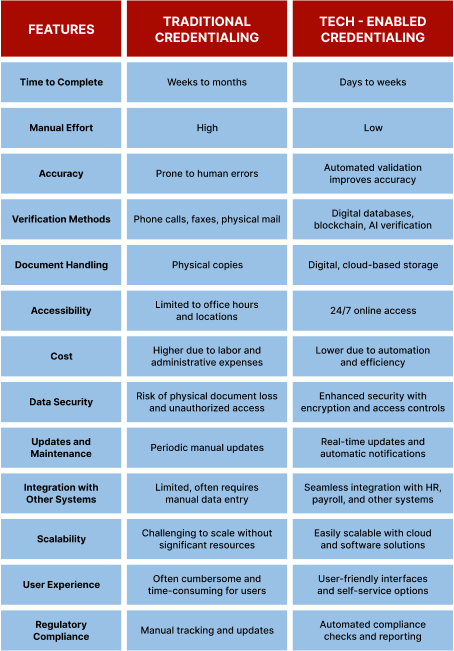
    Traditional vs Tech-enabled

    Benefits and Challenges of AI and Blockchain Adoption

    Benefits:

    • Increased Efficiency: Dramatically reduced processing times for credentialing applications.
    • Improved Accuracy: Reduction in errors associated with manual data entry and verification.
    • Enhanced Security: Better protection against fraud and unauthorized alterations of credentialing data.
    • Cost Savings: Long-term reduction in administrative costs associated with credentialing.
    • Real-Time Updates: Ability to maintain current, accurate credentialing information at all times.

    Challenges:

    • Initial Implementation Costs: Significant investment may be required to adopt these technologies.
    • Integration with Legacy Systems: Challenges in integrating new technologies with existing credentialing systems.
    • Regulatory Compliance: Ensuring that AI and blockchain implementations meet all regulatory requirements.
    • Data Privacy Concerns: Addressing concerns about data privacy and control, especially with blockchain’s immutable nature.
    • Workforce Adaptation: Need for training and potential resistance to change from staff accustomed to traditional processes.

    Real-World Implementations: Pioneers in Tech-Driven Credentialing

    While protecting privacy, let’s look at some anonymized examples of organizations pioneering the use of AI and blockchain in credentialing:

    Case Study 1: National DME Network

    • Implementation: AI-powered credentialing verification system
    • Result: Reduced credentialing processing time by 60% and improved accuracy rates to 99.8%

    Case Study 2: Midwest Healthcare Consortium

    • Implementation: Blockchain-based shared credentialing database
    • Result: Eliminated duplicate credentialing efforts across member organizations, saving an estimated $2 million annually

    Preparing Your DME Business for the Tech-Enabled Future

    As AI and blockchain continue to reshape DME credentialing, here are steps you can take to prepare:

    • Stay Informed: Regularly educate yourself and your team about advancements in credentialing technology.
    • Assess Your Current Process: Identify areas in your credentialing workflow that could benefit from automation or enhanced security.
    • Start Small: Consider piloting AI or blockchain solutions in specific areas of your credentialing process before full-scale implementation.
    • Collaborate: Engage with technology providers, industry associations, and peers to share knowledge and best practices.
    • Invest in Training: Ensure your staff is prepared for the transition to tech-enabled credentialing processes.
    • Plan for Data Migration: Develop a strategy for securely transferring your existing credentialing data to new systems.

    Conclusion:

    The integration of AI and blockchain into DME credentialing represents a significant leap forward for the industry. These technologies offer the potential to dramatically improve efficiency, accuracy, and security in the credentialing process. While challenges exist, the benefits of adoption are becoming increasingly clear.

    As we move further into 2024 and beyond, DME providers who embrace these technological advancements will likely find themselves at a competitive advantage. By streamlining credentialing processes and enhancing data integrity, AI and blockchain can free up resources, allowing providers to focus more on what truly matters: delivering high-quality care to patients.

    How WWS Can Help:

    At WWS, we’re at the forefront of technological advancements in DME credentialing. Our team of experts can help you:

    • Assess your readiness for AI and blockchain integration in your credentialing processes
    • Develop a customized strategy for implementing these technologies in your DME business
    • Provide training and support to ensure a smooth transition to tech-enabled credentialing
    • Stay compliant with evolving regulations surrounding the use of AI and blockchain in healthcare
    • Maximize the benefits of these technologies to streamline your operations and enhance your competitive edge

    Let WWS be your guide in navigating the exciting future of DME credentialing. Our expertise can help you harness the power of AI and blockchain to transform your credentialing processes and drive your business forward.

    CTA:

    Ready to explore how AI and blockchain can revolutionize your DME credentialing process? Schedule an introductory meeting with our technology experts today! Click here to book your Collaborative Discovery Meeting: https://calendly.com/wwshcs/wws-collaborative-discovery-meeting

  • Revolutionizing Credentialing and Contracting: The Latest Technologies and Best Practices for Improved Security and Efficiency

    Revolutionizing Credentialing and Contracting: The Latest Technologies and Best Practices for Improved Security and Efficiency

    Introduction

    The world of credentialing and contracting is changing. The need for security and verification has never been greater, which means that we will continue to see new technology on the market that helps companies manage their employees and contractors. This includes everything from blockchain technology to digital credentialing systems; however, there are still some concerns about how these systems work in practice.

    Digital Credentialing

    Digital credentials are issued by organizations and are electronically verified. They can be used to verify the identity of a person or organization, but they do not replace other forms of identification. Digital credentials can be used in conjunction with traditional forms of identification, such as state-issued driver’s licenses and passports.

    Digital credentialing systems can also help prevent fraud and detect suspicious activity by creating an audit trail that tracks every transaction involving one or more digital credentials (e.g. when a student requests access to an online course).

    Contract Management Software

    Contract management software is a tool that allows you to manage your contracts, agreements, and other business documents. It can used by companies of all sizes and industries to maintain compliance with their contracts by storing them in one central location

     Contract management software can help you do the following: 

    • Manage your entire contact portfolio more efficiently
    • Reduces costs associated with contract administration and management 
    • Improve visibility into key metrics around your contracts 

    Increase opportunities to automate your contract management workflow and improve compliance with industry regulations and standards Improve the efficiency of your contract management process so that you can spend less time on administrative tasks and more time focusing on other areas of your business.  

    Credentialing Automation 

    One of the biggest trends in the industry is credentialing automation, which is a way for companies to reduce costs, increase efficiency, and improve customer service.

    Credentialing automation is a system that allows you to electronically verify a candidate’s qualifications without having someone manually check each one. This saves time for both you and your potential employees, so it can be used by recruiters or hiring managers who want faster results but don’t want their processes bogged down by manual checks on paper documents like transcripts or diplomas.

    The system allows you to upload a file of documents, which it will then check against their database. It can even run facial recognition technology to ensure that the person in the picture is who they say they are. This is helpful when it comes to verifying degrees and transcripts because they usually have watermarks on them that can be scanned automatically by the system without any human intervention required.

    The benefits of credentialing automation are obvious, but it’s also important to understand the limitations. For example, there are times when you need a human being to review documents before confirming them. If someone doesn’t have a high school diploma but claims they do, or if there is an inconsistency in their transcript such as grades not matching up with the year they were supposed to graduate or courses taken not showing up on their degree plan

    Data Security in Contracting

     Data security is an important topic for all businesses, especially those that deal with sensitive information. As more and more companies become aware of the importance of protecting their data, they are looking for ways to make sure that their systems are secure. Several standards and regulations deal with data security:

    • The Payment Card Industry Data Security Standard (PCI DSS) is an international standard developed by credit card companies to protect customer information when it’s being processed by third parties. It requires companies who process credit card transactions to follow specific rules about how they store and handle customer data–for example, requiring encryption when transmitting sensitive information over the Internet or storing passwords securely so they can’t be stolen easily by hackers or other unauthorized users.
    • The Health Insurance Portability & Accountability Act (HIPAA) protects patients’ privacy when using health care services such as hospitals or doctors’ offices; this law makes sure that medical records aren’t shared without authorization from patients themselves.
    Blockchain Technology

    Blockchain is a distributed ledger technology that enables the creation of a public database of transactions. It’s also known as a “digital ledger,” because it records all transactions in an encrypted format that can be accessed by anyone with permission to do so. Blockchain technology was first used by Bitcoin, but it has since been applied in many other industries and contexts–from banking and finance to healthcare and education.

    The benefits of blockchain include increased security (due to its decentralized nature), reduced costs (because there’s no need for intermediaries), and improved efficiency (by reducing bureaucracy).

    Credentialing Standards

    Credentialing standards are needed to ensure that all credentialing organizations are using the same standards so that their credentials can be accurate and trustworthy. Standards also help ensure that credentials are portable between different organizations, so you don’t have to start over if you want to move your career into a new field or state.

    Standards serve as an important bridge between employers, who want assurance of quality in hiring employees; individuals seeking employment, who need information on how they can improve their chances of getting hired; and colleges/universities offering education programs leading up to professional careers

    The latest Trends in Credentialing and Contracting
    Credentialing Automation

    Credentialing automation refers to software designed specifically for managing employee credentials across multiple platforms to streamline processes related to verification and validation of educational achievements (e.g., degrees), licenses/certifications, work experience records, etc., while still maintaining compliance standards set forth by governing bodies such as Accreditation Councils (ACs).

    The use of credentialing automation is growing, as it provides several benefits for both employers and employees including Reduced time spent on resume review and applicant tracking Improved employee satisfaction due to faster hiring processes Reduced costs associated with screening candidates improved employer reputation due to more accurate hiring decisions

    Conclusion

    The world of credentialing and contracting is changing. The need for security and verification has never been greater, which means that we will continue to see new technology on the market that helps companies manage their employees and contractors. This includes everything from blockchain technology to digital credentialing systems; however, there are still some concerns about how these systems work in practice