Category: DME Credentialing

  • Blockchain and Credentialing: Securing the Future of Healthcare Data in 2024

    Blockchain and Credentialing: Securing the Future of Healthcare Data in 2024

    Introduction:

    In the rapidly evolving landscape of healthcare technology, blockchain has emerged as a game-changing force, particularly in the realm of credentialing. As we navigate through 2024, the integration of blockchain into healthcare credentialing systems is not just a futuristic concept—it’s a present reality reshaping how we manage, verify, and secure healthcare provider information. This blog post delves into the transformative impact of blockchain on healthcare credentialing, exploring its benefits, challenges, and the promise it holds for a more secure and efficient healthcare ecosystem.

    Understanding Blockchain in Healthcare Credentialing:

    Before we dive into its applications, let’s demystify blockchain technology in the context of healthcare credentialing:

    Definition: At its core, blockchain is a decentralized, digital ledger that records transactions across multiple computers. In healthcare credentialing, these “transactions” are entries or updates to a provider’s credentials.

    Key Features:

    1. Immutability: Once data is recorded on the blockchain, it cannot be altered without consensus from the network, ensuring the integrity of credential information.
    2. Transparency: All participants in the network can view the entire history of a credential, promoting trust and accountability.
    3. Decentralization: No single entity controls the data, reducing the risk of data manipulation or loss.
    4. Smart Contracts: Automated, self-executing contracts that can streamline verification processes and enforce credentialing rules.

    How Blockchain Applies to Healthcare Credentialing:

    • Creating a tamper-proof record of healthcare provider credentials
    • Enabling real-time verification of qualifications
    • Facilitating secure sharing of credential information across healthcare systems
    • Automating credential updates and renewals through smart contracts

    The Revolutionary Benefits of Blockchain in Credentialing:

    1. Enhanced Data Security:
      • Cryptographic protection against unauthorized alterations
      • Elimination of single points of failure in data storage
      • Reduction in fraudulent credentials through transparent tracking
    2. Improved Efficiency:
      • Streamlined verification processes, reducing credentialing time from weeks to minutes
      • Automated cross-checking of credentials against multiple sources
      • Reduction in administrative burden and associated costs
    3. Real-time Updates and Continuous Validation:
      • Instant reflection of credential changes across the network
      • Continuous monitoring of provider qualifications
      • Automated alerts for expiring credentials or disciplinary actions
    4. Interoperability and Standardization:
      • Seamless sharing of credentialing information across institutions
      • Creation of a universal, standardized format for credential data
      • Facilitation of multi-state licensing and credentialing
    5. Empowering Healthcare Providers:
      • Giving providers more control over their credential information
      • Simplifying the process of sharing credentials with multiple institutions
      • Reducing the need for repetitive submission of credential documentation
    6. Enhancing Patient Trust:
      • Providing a verifiable, transparent record of provider qualifications
      • Enabling patients to easily confirm the credentials of their healthcare providers
      • Improving overall trust in the healthcare system

    Implementation Challenges and Solutions:

    While the potential of blockchain in healthcare credentialing is immense, its implementation comes with certain challenges:

    1. Initial Costs and Infrastructure Requirements:
      Challenge: High upfront investment in blockchain technology and infrastructure
      Solution: Phased implementation approach, starting with pilot programs to demonstrate ROI
    2. Regulatory Compliance and Data Privacy:
      Challenge: Ensuring blockchain systems comply with HIPAA and other healthcare regulations
      Solution: Developing blockchain platforms specifically designed for healthcare, with built-in compliance features
    3. Industry-wide Adoption and Standardization:
      Challenge: Achieving consensus on blockchain standards across the healthcare industry
      Solution: Collaboration with healthcare governing bodies to establish industry-wide blockchain protocols
    4. Integration with Legacy Systems:
      Challenge: Connecting blockchain platforms with existing credentialing databases and software
      Solution: Developing robust APIs and middleware to facilitate seamless integration
    5. Education and Training:
      Challenge: Ensuring healthcare administrators and providers understand and trust blockchain technology
      Solution: Comprehensive training programs and clear communication about the benefits and security of blockchain

    Case Studies: Blockchain in Action

    Several healthcare organizations have already begun implementing blockchain for credentialing, with promising results:

    Case Study 1: National Health Network

    • Implemented a blockchain-based credentialing system in early 2023
    • Reduced credentialing processing time by 80%
    • Achieved 99.9% accuracy in credential verification
    • Saved $3 million annually in administrative costs

    Case Study 2: Multi-State Hospital Consortium

    • Adopted a blockchain platform for sharing provider credentials across 5 states
    • Reduced duplicate credentialing processes by 70%
    • Improved provider satisfaction scores by 45%
    • Facilitated rapid deployment of healthcare providers during emergency situations

    The Future of Blockchain in Healthcare Credentialing:

    As we look beyond 2024, the potential applications of blockchain in healthcare credentialing continue to expand:

    1. Global Credential Portability: International blockchain networks enabling seamless verification of credentials across borders.
    2. Integration with AI and Machine Learning: Predictive analytics for credential management and fraud detection.
    3. Patient-Controlled Health Records: Extending blockchain beyond provider credentials to include comprehensive, patient-controlled health records.
    4. Automated Compliance Management: Smart contracts automatically ensuring ongoing compliance with changing healthcare regulations.
    5. Blockchain-Enabled Telemedicine Credentialing: Facilitating rapid, secure credentialing for telemedicine providers across multiple jurisdictions.

    Conclusion: Embracing the Blockchain Revolution in Healthcare Credentialing

    The integration of blockchain technology into healthcare credentialing represents a paradigm shift in how we manage and verify healthcare provider information. By offering unprecedented levels of security, efficiency, and transparency, blockchain has the potential to solve many of the longstanding challenges in the credentialing process.

    As we continue through 2024 and beyond, healthcare organizations that embrace blockchain technology will find themselves at the forefront of a more secure, efficient, and patient-centric healthcare system. The question is no longer whether blockchain will transform healthcare credentialing, but how quickly organizations will adapt to this new reality.

    How WWS Can Help:

    At WWS, we’re leading the charge in blockchain-enabled credentialing solutions. Our cutting-edge platform leverages the power of blockchain to revolutionize your credentialing processes. We offer:

    • Customized blockchain credentialing solutions tailored to your organization’s specific needs
    • Seamless integration with existing systems and databases
    • Comprehensive training and support to ensure smooth adoption
    • Ongoing updates and enhancements to keep you at the forefront of credentialing technology

    Ready to secure your healthcare data and streamline your credentialing processes with blockchain technology? Let’s start the conversation.

    Schedule an introductory meeting with us today: https://calendly.com/wwshcs/wws-collaborative-discovery-meeting

    Together, we can build a more secure, efficient, and trustworthy healthcare credentialing system for the future.

  • The Hidden Costs of Poor DME Credentialing: Why It Pays to Get It Right

    The Hidden Costs of Poor DME Credentialing: Why It Pays to Get It Right

    Introduction:

    In the competitive world of Durable Medical Equipment (DME), providers often focus on visible costs like equipment and staffing. However, the hidden costs associated with poor credentialing can significantly impact a DME business’s bottom line. As we navigate through 2024, understanding and addressing these hidden costs is more crucial than ever. This blog post will explore the financial implications of inadequate credentialing practices and provide strategies to ensure your DME business stays ahead of the curve.

    The True Cost of Credentialing Errors

    Credentialing mistakes can lead to various financial repercussions:

    1. Claim Denials:
      • Issue: Incorrectly credentialed providers lead to rejected claims.
      • Cost: Potential loss of revenue, increased administrative work for resubmissions.
    2. Delayed Payments:
      • Issue: Incomplete credentialing information slows down the payment process.
      • Cost: Cash flow disruptions, potential need for short-term financing.
    3. Network Exclusion:
      • Issue: Failure to meet credentialing standards can result in network exclusion.
      • Cost: Loss of patient volume, reduced market share.
    4. Compliance Penalties:
      • Issue: Non-compliance with credentialing requirements can lead to fines.
      • Cost: Direct financial penalties, potential legal fees.

    The Ripple Effect on Operations

    Poor credentialing doesn’t just affect your bottom line; it can disrupt your entire operation:

    1. Administrative Burden:
      • Issue: Constantly addressing credentialing issues diverts staff from other tasks.
      • Cost: Reduced operational efficiency, potential need for additional staff.
    2. Provider Frustration:
      • Issue: Credentialing problems can frustrate and demotivate your team.
      • Cost: Potential turnover, recruitment and training expenses.
    3. Reputation Damage:
      • Issue: Credentialing errors can harm your reputation with payers and patients.
      • Cost: Lost business opportunities, marketing expenses to rebuild trust.

    The Investment in Proper Credentialing

    While robust credentialing processes require investment, the returns are substantial:

    1. Technology Solutions:
      • Investment: Implementing credentialing software and databases.
      • Return: Streamlined processes, reduced errors, better data management.
    2. Staff Training:
      • Investment: Ongoing education for credentialing staff.
      • Return: Fewer mistakes, more efficient processes, ability to handle complex cases.
    3. Quality Assurance Measures:
      • Investment: Implementing rigorous QA processes for credentialing.
      • Return: Reduced denials, faster approvals, improved payer relationships.

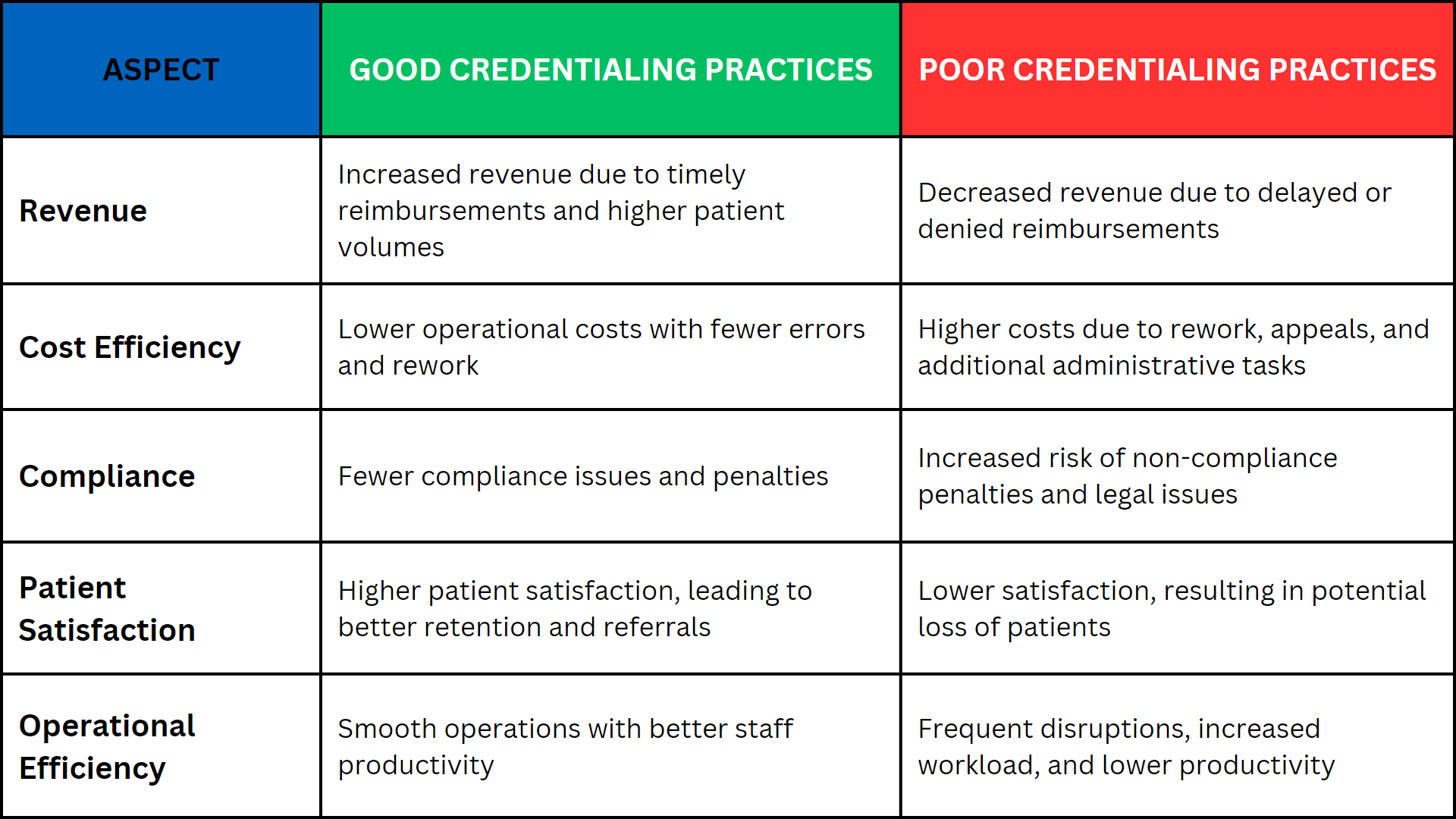
    Financial Impact of Good vs. Poor Credentialing Practices

    Best Practices to Minimize Hidden Costs

    Implement these strategies to optimize your credentialing process:

    1. Centralize Credentialing Operations:
      • Create a dedicated credentialing department or team.
      • Implement standardized processes across all payers and providers.
    2. Leverage Technology:
      • Invest in robust credentialing software.
      • Utilize automated verification services for real-time updates.
    3. Implement Proactive Monitoring:
      • Set up alerts for expiring credentials.
      • Regularly audit credentialing files for completeness and accuracy.
    4. Prioritize Ongoing Education:
      • Keep staff updated on changing regulations and payer requirements.
      • Encourage professional certifications in healthcare credentialing.

    Measuring the ROI of Effective Credentialing

    To justify investments in credentialing, track these key metrics:

    1. Claim Denial Rate:
      • Monitor the percentage of claims denied due to credentialing issues.
      • Set goals for continuous improvement.
    2. Days in Accounts Receivable:
      • Track how quickly you’re paid after submitting claims.
      • Look for improvements as credentialing processes are optimized.
    3. Provider Onboarding Time:
      • Measure how long it takes to fully credential new providers.
      • Aim to reduce this time without sacrificing accuracy.
    4. Audit Performance:
      • Track your performance in payer audits.
      • Use results to identify areas for improvement in your credentialing process.

    Conclusion:

    The hidden costs of poor DME credentialing can significantly impact your business’s financial health and operational efficiency. By recognizing these costs and implementing best practices, you can transform your credentialing process from a potential liability into a strategic asset.

    Investing in proper credentialing is not just about avoiding costs; it’s about creating a foundation for sustainable growth and success in the competitive DME market. As we continue through 2024, those providers who prioritize excellence in credentialing will be best positioned to thrive, building strong relationships with payers, providers, and patients alike.

    How WWS Can Help:

    At Wonder Worth Solutions (WWS), we understand the critical role that effective credentialing plays in the success of DME providers. Our team of experts can help you:

    • Assess your current credentialing processes and identify areas for improvement
    • Implement cutting-edge credentialing technologies tailored to your needs
    • Develop comprehensive training programs for your credentialing staff
    • Create robust quality assurance measures to minimize errors and denials
    • Optimize your credentialing operations for maximum efficiency and ROI

    Let WWS be your partner in transforming your DME credentialing from a cost center into a strategic advantage. Our expertise can help you navigate the complexities of credentialing, reduce hidden costs, and position your business for sustainable growth.

    CTA:

    Ready to uncover and eliminate the hidden costs in your DME credentialing process? Let’s work together to optimize your operations and boost your bottom line. Schedule your Collaborative Discovery Meeting with our credentialing experts today!
    Click here to book: https://calendly.com/wwshcs/wws-collaborative-discovery-meeting

  • Mastering DME Provider Credentialing: Expert Strategies for Success in 2024

    Mastering DME Provider Credentialing: Expert Strategies for Success in 2024

    Introduction:

    In the ever-evolving landscape of Durable Medical Equipment (DME) provision, robust credentialing remains a cornerstone of success. As we navigate through 2024, the credentialing process continues to grow in complexity, requiring DME providers to stay ahead of the curve. This comprehensive guide will equip you with expert strategies to master DME provider credentialing, helping you avoid common pitfalls and position your business for sustainable growth.

    Understanding the Evolving Landscape of DME Credentialing

    The DME credentialing landscape in 2024 is characterized by:

    • Increased scrutiny from payers and regulatory bodies
    • Growing emphasis on quality metrics and patient outcomes
    • Integration of telehealth and remote patient monitoring considerations
    • Rising importance of cybersecurity and data protection measures

    Key action: Stay informed about industry changes through professional associations, regulatory updates, and continuing education.

    Building a Robust Credentialing Infrastructure

    A solid credentialing foundation is crucial for long-term success:

    1. Centralized Credentialing System:
      • Implement a centralized, digital system for managing all credentialing documentation
      • Ensure easy accessibility and regular updates of critical information
    2. Dedicated Credentialing Team:
      • Assign staff specifically to oversee credentialing processes
      • Invest in ongoing training to keep the team updated on best practices
    3. Standardized Processes:
      • Develop clear, written procedures for all aspects of credentialing
      • Create checklists and timelines to ensure consistency and completeness
    4. Proactive Renewal Management:
      • Implement an alert system for upcoming expirations and renewals
      • Begin renewal processes well in advance to avoid lapses

    Leveraging Technology for Efficient Credentialing

    Embrace technological solutions to streamline your credentialing process:

    1. Credentialing Software:
      • Invest in specialized credentialing software to automate data collection and verification
      • Look for solutions that offer integration with other business systems
    2. Digital Document Management:
      • Implement secure, cloud-based storage for all credentialing documents
      • Ensure easy retrieval and sharing of information when needed
    3. Automated Verification:
      • Utilize services that offer real-time verification of licenses and certifications
      • Implement systems for continuous monitoring of exclusion lists and sanctions

    Navigating Payer-Specific Requirements

    Different payers often have unique credentialing requirements. Develop strategies to manage these effectively:

    1. Payer Matrix:
      • Create a comprehensive matrix of all payer requirements
      • Regularly update this matrix to reflect changes in payer policies
    2. Tailored Application Packages:
      • Develop customized application packages for each major payer
      • Include all necessary documentation to expedite the review process
    3. Relationship Management:
      • Foster positive relationships with payer credentialing departments
      • Maintain open lines of communication to address issues promptly

    Quality Assurance in Credentialing

    Implement robust quality assurance measures to minimize errors and ensure compliance:

    1. Internal Audits:
      • Conduct regular internal audits of your credentialing files
      • Address any discrepancies or incomplete information promptly
    2. Peer Review:
      • Implement a peer review system for credentialing applications
      • Have a second set of eyes review all submissions for accuracy
    3. Ongoing Education:
      • Provide regular training to staff on credentialing best practices
      • Stay updated on regulatory changes and industry standards

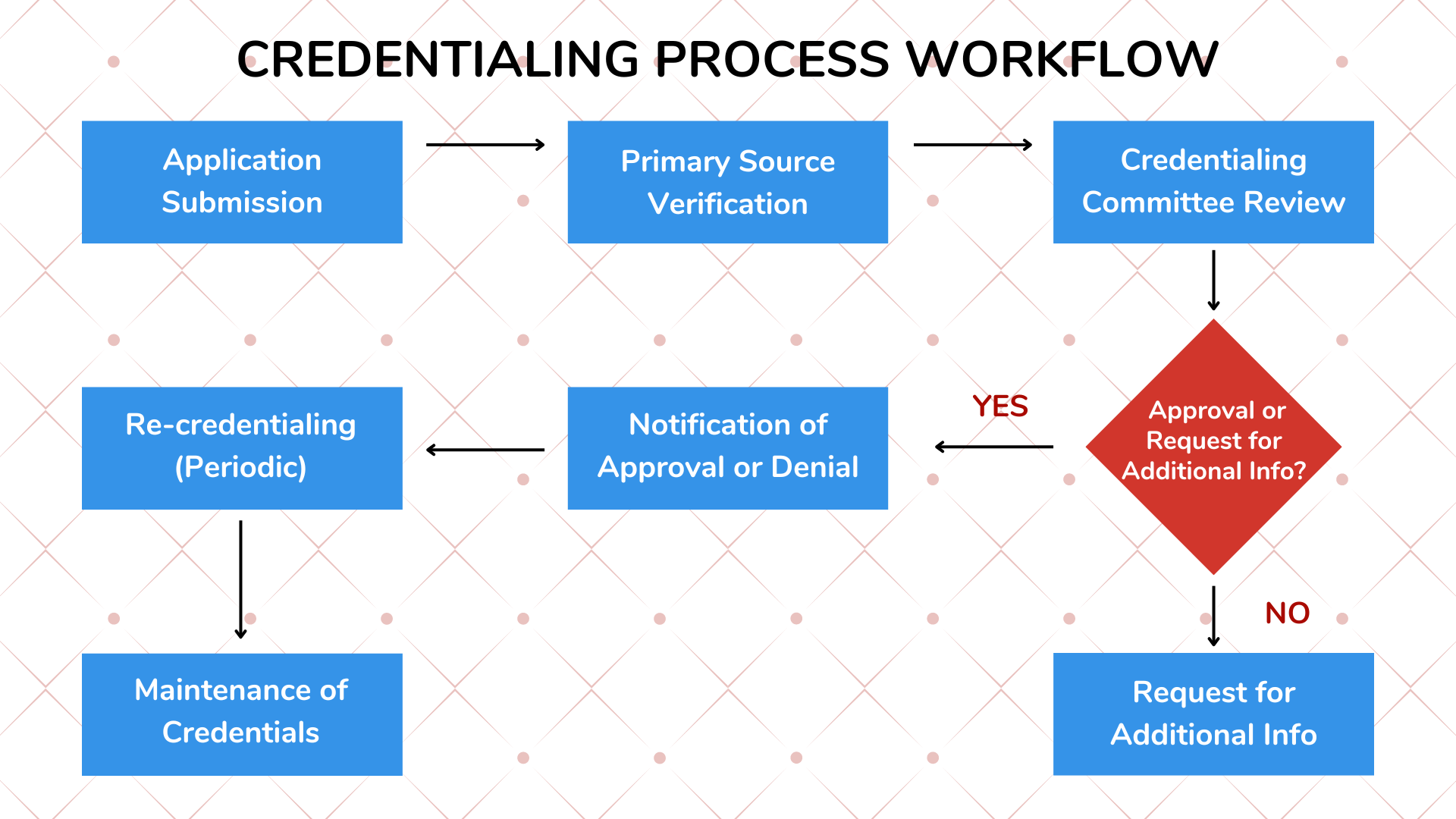
    Credentialing Process Workflow

    Addressing Common Credentialing Challenges

    Be prepared to tackle these frequent credentialing hurdles:

    1. Incomplete Applications:
      • Develop a thorough pre-submission checklist
      • Implement a system for tracking and quickly addressing information requests
    2. Delays in Primary Source Verification:
      • Maintain direct contacts at primary sources
      • Consider using Credential Verification Organizations (CVOs) for efficiency
    3. Keeping Up with Regulatory Changes:
      • Subscribe to regulatory update services
      • Assign team members to monitor and report on relevant changes
    4. Managing Multi-State Credentialing:
      • Develop a clear understanding of each state’s unique requirements
      • Consider partnering with local experts in states where you’re expanding

    Preparing for the Future of DME Credentialing

    Stay ahead of the curve by anticipating future trends:

    1. Value-Based Credentialing:
      • Begin incorporating quality metrics and patient outcome data into your credentialing processes
      • Develop systems for tracking and reporting on these metrics
    2. Enhanced Cybersecurity Requirements:
      • Strengthen your data protection measures
      • Consider obtaining cybersecurity certifications relevant to healthcare
    3. Telehealth Integration:
      • Ensure your credentialing processes account for telehealth services
      • Stay informed about evolving regulations around remote patient monitoring

    Conclusion:

    Mastering DME provider credentialing in 2024 requires a multifaceted approach that combines technological innovation, process optimization, and a commitment to quality and compliance. By implementing these expert strategies, you can transform credentialing from a necessary burden into a competitive advantage for your DME business.

    Remember, effective credentialing is not just about meeting minimum requirements—it’s about demonstrating your commitment to excellence and building trust with payers, healthcare providers, and patients. As the healthcare landscape continues to evolve, those who excel in credentialing will be best positioned to thrive and grow.

    I apologize for the confusion, and thank you for the correction. I’ll make sure to use the correct company name, Wonder Worth Solutions (WWS), in all future content. Let me update the “How WWS Can Help” section of the last blog post to reflect this:

    How WWS Can Help:

    At Wonder Worth Solutions (WWS), we specialize in helping DME providers navigate the complex world of credentialing. Our expert team can assist you in:

    • Developing a customized credentialing strategy tailored to your business needs
    • Implementing efficient credentialing processes and technologies
    • Staying compliant with ever-changing regulatory requirements
    • Preparing for and managing payer audits
    • Optimizing your credentialing to support business growth and expansion

    Let WWS be your partner in mastering DME provider credentialing. Our expertise can help you transform your credentialing processes, reduce administrative burden, and position your business for success in the competitive DME market.

    CTA:

    Ready to elevate your DME credentialing to the next level? Let’s work together to create a credentialing strategy that drives your business forward. Schedule your Collaborative Discovery Meeting with our credentialing experts today! Click here to book: https://calendly.com/wwshcs/wws-collaborative-discovery-meeting