Category: DME provider efficiency

  • The Complete Guide to DME Credentialing in 2024: Part 1 – Getting Started

    The Complete Guide to DME Credentialing in 2024: Part 1 – Getting Started

    Introduction:

    In the ever-evolving landscape of healthcare, Durable Medical Equipment (DME) providers play a crucial role in delivering essential medical supplies and equipment to patients. However, before you can serve this vital function, you must navigate the complex world of DME credentialing. This comprehensive guide will walk you through the fundamentals of DME credentialing in 2024, helping you understand the process, requirements, and initial steps to launch your credentialing journey successfully.

    What is DME Credentialing?

    DME credentialing is the process by which healthcare payers, including Medicare, Medicaid, and private insurance companies, verify and assess the qualifications of DME providers. This rigorous evaluation ensures that providers meet specific standards of quality, safety, and compliance before they can bill for services or equipment.

    Key aspects of DME credentialing include:

    • Verification of licensure and certification
    • Confirmation of education and training
    • Assessment of business practices and financial stability
    • Evaluation of compliance with healthcare regulations
    • Review of liability insurance coverage

    The Importance of Proper Credentialing in 2024

    As we navigate through 2024, proper credentialing has become more critical than ever for DME providers. Here’s why:

    • Regulatory Compliance: With increasing scrutiny on healthcare providers, maintaining proper credentials ensures you meet all legal and regulatory requirements.
    • Patient Trust: Credentialing demonstrates your commitment to quality care, building trust with patients and healthcare partners.
    • Financial Stability: Without proper credentialing, you can’t bill payers for your services, severely impacting your business’s financial health.
    • Competitive Advantage: In a crowded market, being fully credentialed sets you apart from less qualified providers.
    • Risk Mitigation: Credentialing helps protect your business from potential legal and financial risks associated with non-compliance.

    Key Players in the DME Credentialing Process

    Understanding the roles of various entities involved in DME credentialing is crucial for navigating the process effectively:

    • Centers for Medicare & Medicaid Services (CMS): Sets standards for Medicare and Medicaid DME providers.
    • National Supplier Clearinghouse (NSC): Handles the enrollment and credentialing process for Medicare DME suppliers.
    • Accreditation Organizations: Entities like The Joint Commission or ACHC that assess and accredit DME providers.
    • Private Payers: Insurance companies with their own credentialing requirements and processes.
    • Credentialing Verification Organizations (CVOs): Third-party entities that often handle credentialing on behalf of payers.

    Essential Documents and Requirements

    To begin the credentialing process, you’ll need to gather several essential documents and meet specific requirements. Here’s a checklist to get you started:

    • Business licenses and registrations
    • National Provider Identifier (NPI) number
    • Tax ID number (EIN)
    • Proof of liability insurance
    • Accreditation certificates
    • Owner and key personnel information
    • Financial statements
    • Policies and procedures documentation
    • Product and service lists
    • Facility information and photos

    Initial Steps to Start Your Credentialing Journey
    Credentialing Journey

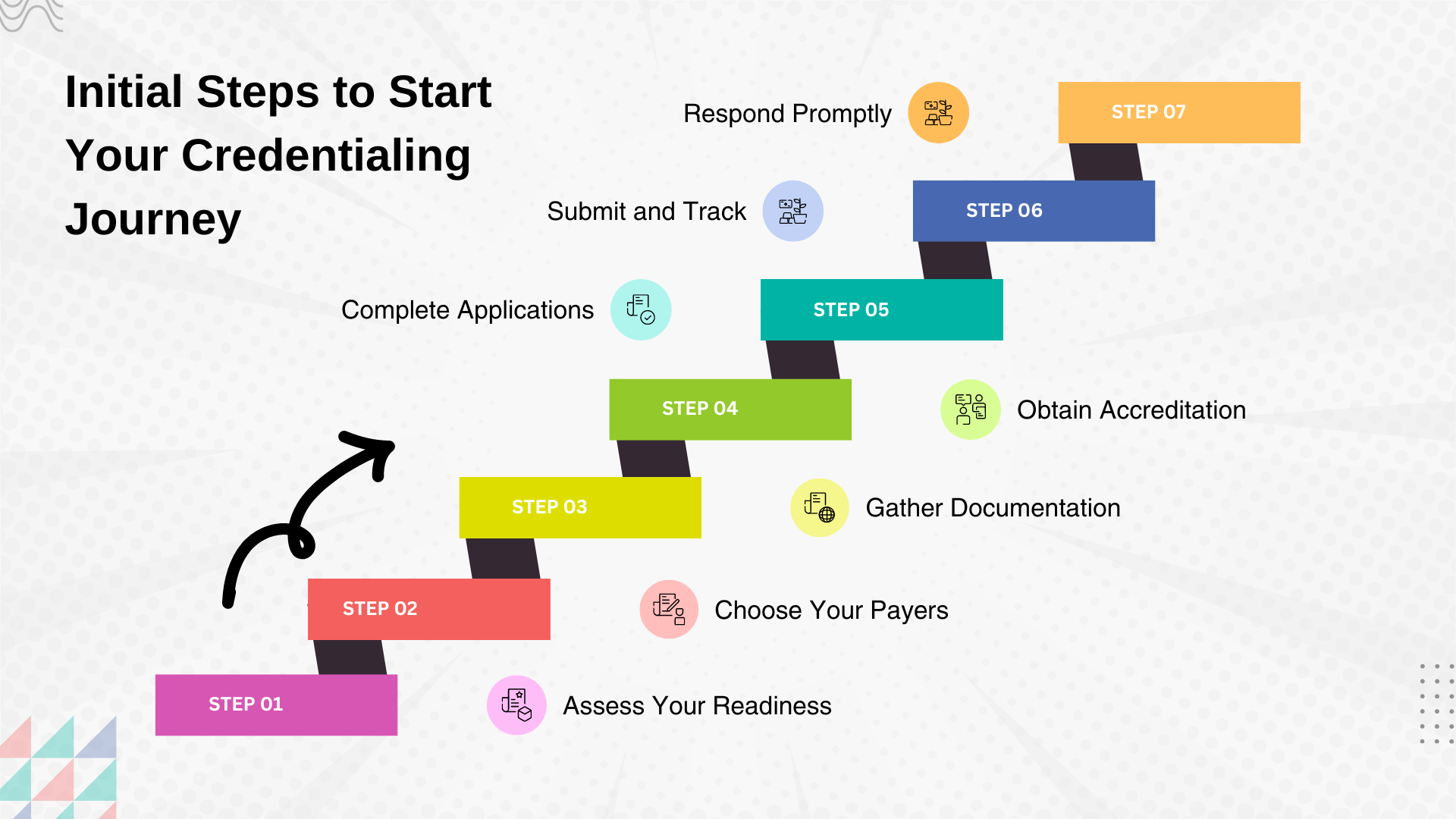
    Now that you understand the basics, here are the initial steps to launch your DME credentialing process:

    a) Assess Your Readiness: Review all requirements and ensure your business meets the necessary standards.

    b) Choose Your Payers: Decide which payers you want to work with (Medicare, Medicaid, private insurers) and prioritize your applications.

    c) Gather Documentation: Collect all required documents listed in the previous section.

    d) Obtain Accreditation: If not already accredited, begin the process with a recognized accrediting organization.

    e) Complete Applications: Start with Medicare enrollment through PECOS (Provider Enrollment, Chain, and Ownership System) if applicable.

    f) Submit and Track: Send in your applications and diligently track their progress.

    g) Respond Promptly: Be prepared to quickly respond to any requests for additional information.

    Common Challenges for New DME Providers

    As you embark on your credentialing journey, be aware of these common challenges:

    • Time-consuming process: Credentialing can take several months. Start early and be patient.
    • Complex documentation: Ensuring all paperwork is complete and accurate can be daunting.
    • Changing requirements: Stay informed about updates to credentialing standards and regulations.
    • Multiple payer processes: Each payer may have different requirements and systems.
    • Maintaining credentials: Remember that credentialing is an ongoing process, not a one-time task.

    Conclusion:

    Embarking on your DME credentialing journey in 2024 may seem overwhelming, but with the right knowledge, preparation, and support, you can navigate the process successfully. This guide has provided you with a solid foundation to understand DME credentialing, its importance, key players, essential requirements, and initial steps to get started. In Part 2 of this guide, we’ll delve deeper into advanced strategies for successful credentialing and maintaining your credentials over time.
    Remember, proper credentialing is not just a regulatory requirement—it’s a testament to your commitment to quality care and a key factor in your business’s success. Stay tuned for more insights and expert advice on mastering DME credentialing in 2024 and beyond.

    How WWS Can Help:

    At (WWS), we understand the complexities of DME credentialing and are here to support you every step of the way. Our team of experts can guide you through the entire credentialing process, helping you avoid common pitfalls and ensure a smooth, efficient experience. We offer:

    • Comprehensive credentialing support
    • Expert guidance on regulatory compliance
    • Assistance with document preparation and submission
    • Ongoing monitoring and maintenance of your credentials

    Don’t navigate the credentialing maze alone. Let WWS be your trusted partner in achieving and maintaining your DME credentials.

    CTA:

    Ready to streamline your DME credentialing process? Schedule an introductory meeting with our experts today! Click here to book your Collaborative Discovery Meeting: https://calendly.com/wwshcs/wws-collaborative-discovery-meeting
  • Leveraging Technology to Simplify Credentialing and Contracting for DME Providers

    Leveraging Technology to Simplify Credentialing and Contracting for DME Providers

    In the ever-evolving world of Durable Medical Equipment (DME), providers face increasing pressure to streamline operations while maintaining compliance and quality of service. Two areas where technology can make a significant impact are credentialing and contracting. This blog post explores how DME providers can leverage innovative tech solutions to simplify these critical processes.

    The Tech Revolution in DME Credentialing and Contracting

    The traditional approach to credentialing and contracting often involves manual data entry, paper-based document management, and time-consuming follow-ups. However, technological advancements are transforming these processes, offering DME providers opportunities to:

    1. Reduce administrative burden
    2. Minimize errors and inconsistencies
    3. Speed up approval processes
    4. Improve data accuracy and security
    5. Enhance overall operational efficiency

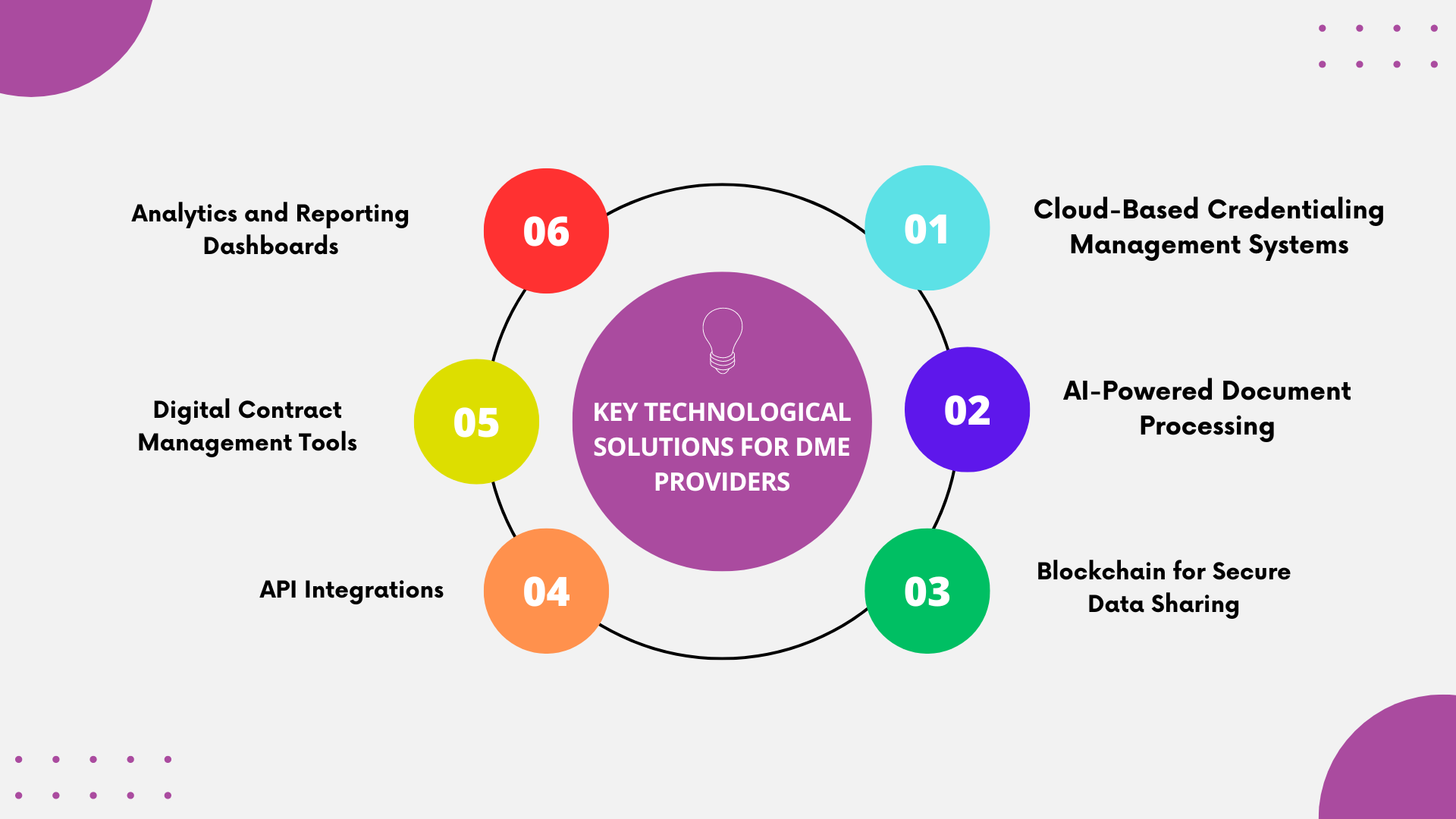
    Key Technological Solutions for DME Providers

    Key Technological Solutions

    1. Cloud-Based Credentialing Management Systems
    – Centralized data storage for easy access and updates
    – Automated reminders for expirations and renewals
    – Real-time status tracking of credentialing applications

    2. AI-Powered Document Processing
    – Intelligent character recognition for quick data extraction from documents
    – Automated verification of credential authenticity
    – Flagging of discrepancies or missing information

    3. Blockchain for Secure Data Sharing
    – Immutable record of credentialing history
    – Secure sharing of verified credentials with multiple stakeholders
    – Reduction in redundant verification processes

    4. API Integrations
    – Seamless data exchange between credentialing platforms and payer systems
    – Real-time updates to CAQH ProView and other industry databases
    – Integration with existing DME management software

    5. Digital Contract Management Tools
    – Electronic signature capabilities for faster contract executions
    – Version control and audit trails for all contract changes
    – Automated contract renewal notifications

    6. Analytics and Reporting Dashboards
    – Real-time insights into credentialing and contracting status
    – Identification of bottlenecks in the processes
    – Data-driven decision making for process improvements

    Overcoming Implementation Challenges

    While the benefits of technology adoption are clear, DME providers may face several challenges:

    1.Initial Costs: Implementing new technology often requires upfront investment. However, the long-term savings in time and resources typically outweigh these costs.

    2.Learning Curve: Staff may need training to effectively use new systems. Choosing user-friendly solutions and providing comprehensive training can mitigate this challenge.

    3.Data Migration: Moving from legacy systems to new platforms can be complex. Careful planning and expert assistance can ensure smooth data transition.

    4.Compliance Concerns: Ensure that any tech solution adopted complies with healthcare regulations like HIPAA. Look for vendors with strong track records in healthcare compliance.

    5.Integration with Existing Systems: New technology should integrate seamlessly with your current DME management systems. Prioritize solutions that offer robust API capabilities.

    Measuring the Impact of Tech Adoption

    Measuring the Impact

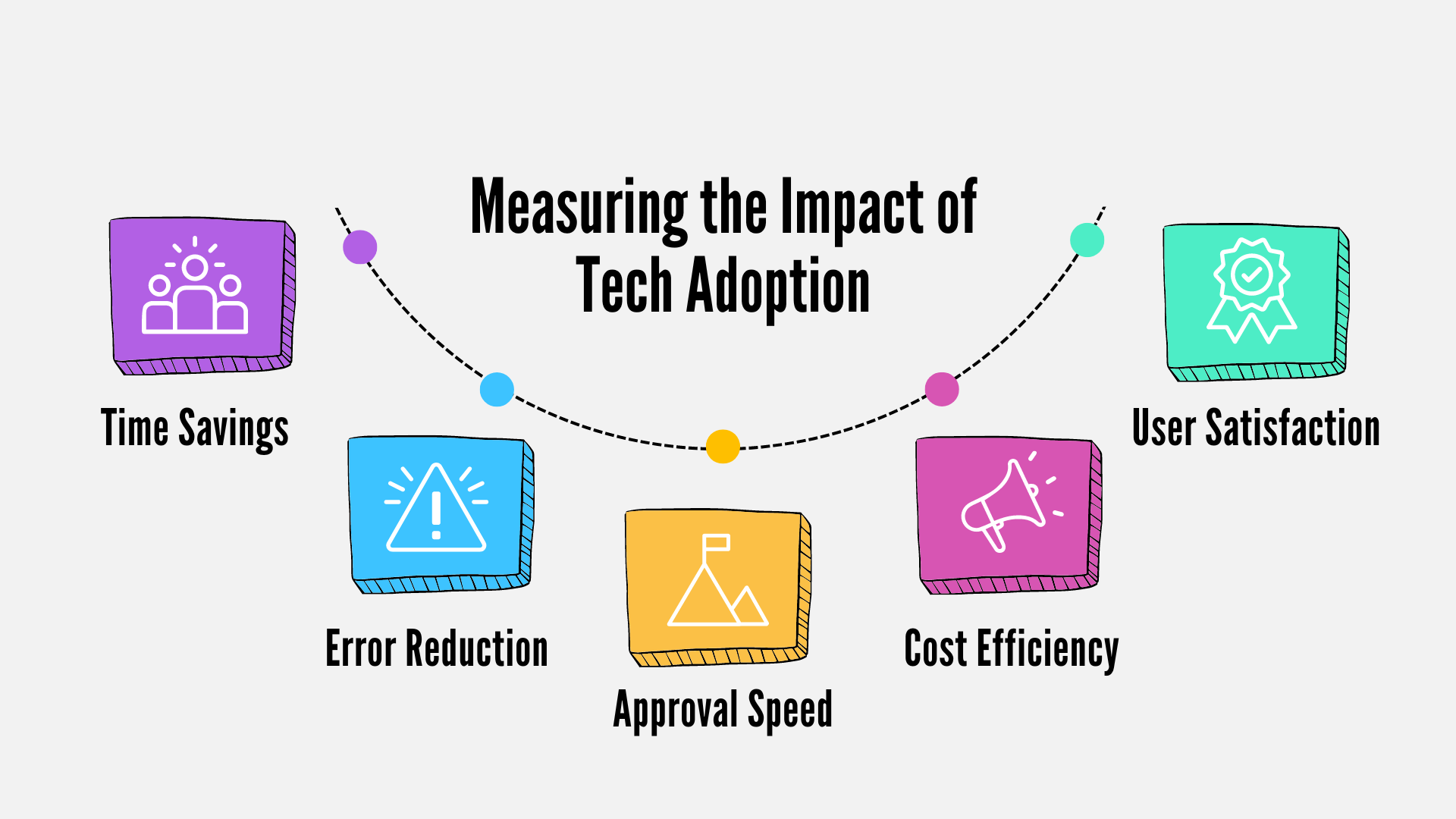
    To justify the investment in technology, it’s crucial to measure its impact:

    1.Time Savings: Track the reduction in time spent on credentialing and contracting tasks.

    2.Error Reduction: Monitor the decrease in data entry errors and inconsistencies.

    3.Approval Speed: Measure the improvement in credentialing approval times.

    4.Cost Efficiency: Calculate the savings in administrative costs and potential revenue increases from faster contracting.

    5.User Satisfaction: Gather feedback from staff and partners on the new processes.

    How WWS Empowers DME Providers with Cutting-Edge Technology

    At WWS, we are at the forefront of technological innovation in DME credentialing and contracting. We’re excited to announce the upcoming launch of X-Propeller, our state-of-the-art AI Integrated Credentialing & Contracting Platform. This revolutionary platform embodies our commitment to empowering DME providers with the most advanced technology solutions.

    X-Propeller will offer:

    -AI-Driven Credentialing: Leveraging artificial intelligence to streamline the entire credentialing process, from data collection to verification.

    -Smart Contract Management: AI-powered contract analysis and negotiation support, ensuring optimal terms for DME providers.

    -Predictive Analytics: Advanced algorithms to forecast credentialing and contracting trends, helping providers stay ahead of industry changes.

    -Automated Compliance Checks: Real-time monitoring of regulatory requirements and automatic updates to maintain compliance.

    -Integrated Workflow Management: Seamless coordination of credentialing and contracting tasks across your organization.

    While we put the finishing touches on X-Propeller, our current comprehensive solution suite continues to provide cutting-edge support:

    -Integrated Credentialing Platform: Our cloud-based system centralizes all credentialing data, automates routine tasks, and provides real-time status updates.

    -Smart Contract Management: Our AI-powered contract tools streamline negotiations, automate renewals, and ensure compliance with the latest regulations.

    -Secure Data Exchange: Leveraging blockchain technology, we offer secure and efficient sharing of credentialing information with payers and healthcare partners.

    -Custom API Solutions: We provide tailored API integrations to connect our platform seamlessly with your existing DME management systems.

    -Advanced Analytics: Our reporting dashboards offer deep insights into your credentialing and contracting processes, helping you identify opportunities for improvement.

    -Ongoing Support and Training: We ensure your team is fully equipped to leverage our technology with comprehensive training and responsive support.

    How WWS Can Help

    By partnering with WWS, DME providers gain access to current cutting-edge solutions and are positioned to be early adopters of X-Propeller upon its launch. This ensures you’ll always be at the forefront of technological advancements in credentialing and contracting.

    Our technology solutions not only save time and reduce errors but also position your business for scalable growth in the competitive DME market. With WWS and the upcoming X-Propeller platform, you can transform your credentialing and contracting processes from potential bottlenecks into streamlined, efficient operations powered by the latest in AI and automation.

    Embracing technology in credentialing and contracting is no longer optional for DME providers—it’s a necessity for staying competitive and efficient in today’s healthcare landscape. With WWS’s current solutions and the forthcoming X-Propeller platform, you can focus less on paperwork and more on what matters most: providing quality care to your patients.

    References and Further Reading:

    1. HIMSS – Healthcare Information and Management Systems Society: https://www.himss.org/

    2. HealthIT.gov – Health Information Technology: https://www.healthit.gov/