
Category: Provider qualification

  • The Complete Guide to DME Credentialing in 2024: Part 1 – Getting Started

    The Complete Guide to DME Credentialing in 2024: Part 1 – Getting Started

    Introduction:

    In the ever-evolving landscape of healthcare, Durable Medical Equipment (DME) providers play a crucial role in delivering essential medical supplies and equipment to patients. However, before you can serve this vital function, you must navigate the complex world of DME credentialing. This comprehensive guide will walk you through the fundamentals of DME credentialing in 2024, helping you understand the process, requirements, and initial steps to launch your credentialing journey successfully.

    What is DME Credentialing?

    DME credentialing is the process by which healthcare payers, including Medicare, Medicaid, and private insurance companies, verify and assess the qualifications of DME providers. This rigorous evaluation ensures that providers meet specific standards of quality, safety, and compliance before they can bill for services or equipment.

    Key aspects of DME credentialing include:

    • Verification of licensure and certification
    • Confirmation of education and training
    • Assessment of business practices and financial stability
    • Evaluation of compliance with healthcare regulations
    • Review of liability insurance coverage

    The Importance of Proper Credentialing in 2024

    As we navigate through 2024, proper credentialing has become more critical than ever for DME providers. Here’s why:

    • Regulatory Compliance: With increasing scrutiny on healthcare providers, maintaining proper credentials ensures you meet all legal and regulatory requirements.
    • Patient Trust: Credentialing demonstrates your commitment to quality care, building trust with patients and healthcare partners.
    • Financial Stability: Without proper credentialing, you can’t bill payers for your services, severely impacting your business’s financial health.
    • Competitive Advantage: In a crowded market, being fully credentialed sets you apart from less qualified providers.
    • Risk Mitigation: Credentialing helps protect your business from potential legal and financial risks associated with non-compliance.

    Key Players in the DME Credentialing Process

    Understanding the roles of various entities involved in DME credentialing is crucial for navigating the process effectively:

    • Centers for Medicare & Medicaid Services (CMS): Sets standards for Medicare and Medicaid DME providers.
    • National Supplier Clearinghouse (NSC): Handles the enrollment and credentialing process for Medicare DME suppliers.
    • Accreditation Organizations: Entities like The Joint Commission or ACHC that assess and accredit DME providers.
    • Private Payers: Insurance companies with their own credentialing requirements and processes.
    • Credentialing Verification Organizations (CVOs): Third-party entities that often handle credentialing on behalf of payers.

    Essential Documents and Requirements

    To begin the credentialing process, you’ll need to gather several essential documents and meet specific requirements. Here’s a checklist to get you started:

    • Business licenses and registrations
    • National Provider Identifier (NPI) number
    • Tax ID number (EIN)
    • Proof of liability insurance
    • Accreditation certificates
    • Owner and key personnel information
    • Financial statements
    • Policies and procedures documentation
    • Product and service lists
    • Facility information and photos

    Initial Steps to Start Your Credentialing Journey
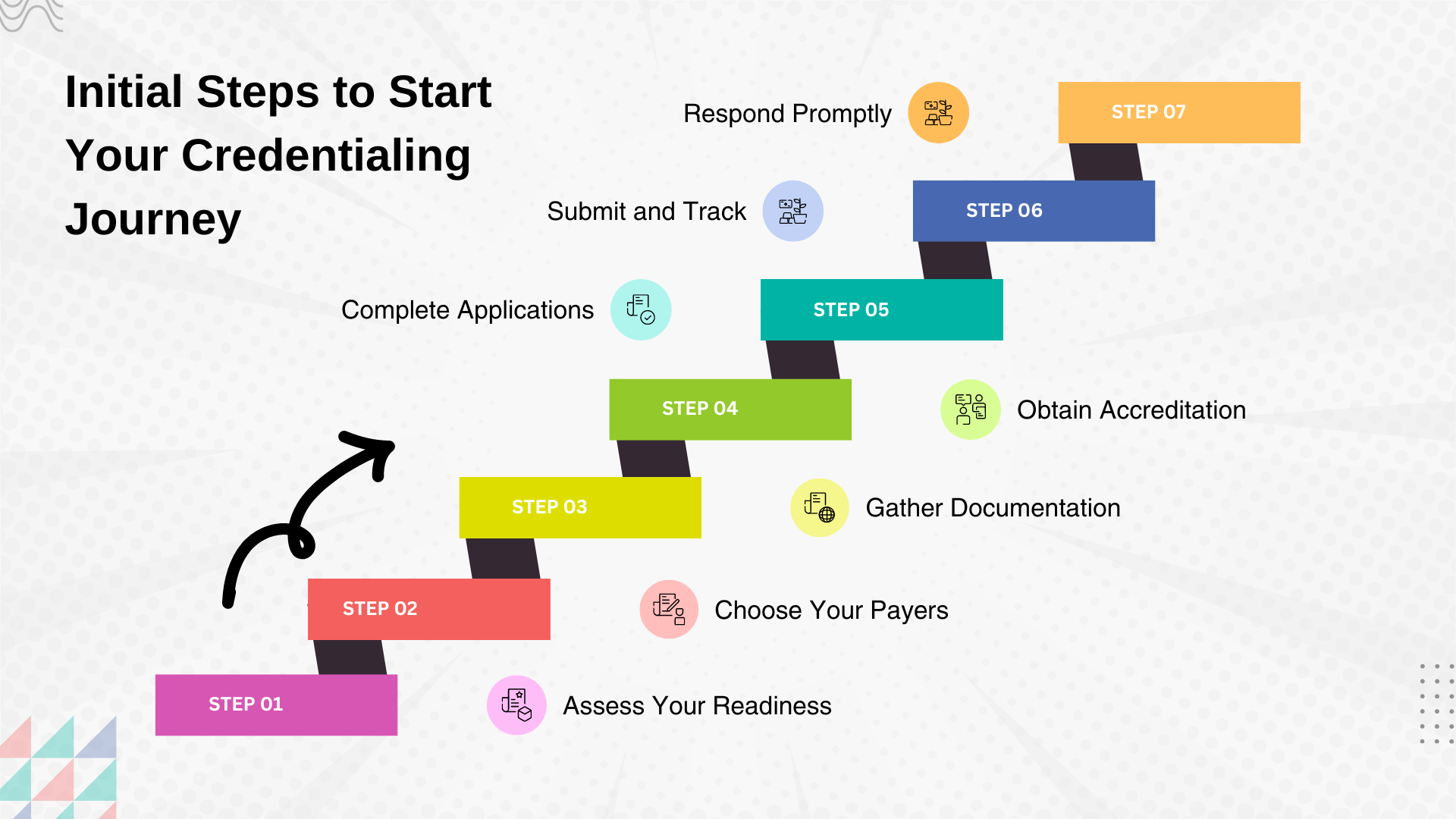
    Credentialing Journey

    Now that you understand the basics, here are the initial steps to launch your DME credentialing process:

    a) Assess Your Readiness: Review all requirements and ensure your business meets the necessary standards.

    b) Choose Your Payers: Decide which payers you want to work with (Medicare, Medicaid, private insurers) and prioritize your applications.

    c) Gather Documentation: Collect all required documents listed in the previous section.

    d) Obtain Accreditation: If not already accredited, begin the process with a recognized accrediting organization.

    e) Complete Applications: Start with Medicare enrollment through PECOS (Provider Enrollment, Chain, and Ownership System) if applicable.

    f) Submit and Track: Send in your applications and diligently track their progress.

    g) Respond Promptly: Be prepared to quickly respond to any requests for additional information.

    Common Challenges for New DME Providers

    As you embark on your credentialing journey, be aware of these common challenges:

    • Time-consuming process: Credentialing can take several months. Start early and be patient.
    • Complex documentation: Ensuring all paperwork is complete and accurate can be daunting.
    • Changing requirements: Stay informed about updates to credentialing standards and regulations.
    • Multiple payer processes: Each payer may have different requirements and systems.
    • Maintaining credentials: Remember that credentialing is an ongoing process, not a one-time task.

    Conclusion:

    Embarking on your DME credentialing journey in 2024 may seem overwhelming, but with the right knowledge, preparation, and support, you can navigate the process successfully. This guide has provided you with a solid foundation to understand DME credentialing, its importance, key players, essential requirements, and initial steps to get started. In Part 2 of this guide, we’ll delve deeper into advanced strategies for successful credentialing and maintaining your credentials over time.
    Remember, proper credentialing is not just a regulatory requirement—it’s a testament to your commitment to quality care and a key factor in your business’s success. Stay tuned for more insights and expert advice on mastering DME credentialing in 2024 and beyond.

    How WWS Can Help:

    At (WWS), we understand the complexities of DME credentialing and are here to support you every step of the way. Our team of experts can guide you through the entire credentialing process, helping you avoid common pitfalls and ensure a smooth, efficient experience. We offer:

    • Comprehensive credentialing support
    • Expert guidance on regulatory compliance
    • Assistance with document preparation and submission
    • Ongoing monitoring and maintenance of your credentials

    Don’t navigate the credentialing maze alone. Let WWS be your trusted partner in achieving and maintaining your DME credentials.

    CTA:

    Ready to streamline your DME credentialing process? Schedule an introductory meeting with our experts today! Click here to book your Collaborative Discovery Meeting: https://calendly.com/wwshcs/wws-collaborative-discovery-meeting
  • Understanding the Role of Credentialing in Healthcare Contracting

    Understanding the Role of Credentialing in Healthcare Contracting

    Introduction:

    Credentialing is a vital process in the healthcare industry that verifies healthcare providers’ qualifications, skills, and experience. In this blog post, we will discuss the importance of credentialing in the healthcare industry and how it affects healthcare contracts, quality assurance, compliance with regulatory requirements, reimbursement and payment accuracy, legal and liability considerations, patient satisfaction, and trust.

    Why Is Credentialing Necessary in Healthcare Contracting?

    Credentialing is the process of verifying a healthcare provider’s qualifications and skills to ensure that only qualified and competent professionals provide care to patients. It helps healthcare organizations identify professionals who meet the necessary standards of care and who are legally authorized to provide medical care. Credentialing is essential for healthcare providers who wish to participate in government-funded healthcare programs such as Medicare and Medicaid. Finally, credentialing plays a crucial role in managing liability and risk for healthcare organizations. It helps them mitigate risk by ensuring that only qualified and competent providers are providing medical care.

    How Does Credentialing Work?

    Credentialing is a comprehensive process conducted by healthcare organizations to evaluate and verify the qualifications, experience, and credentials of healthcare providers. It ensures that healthcare professionals meet the necessary standards of care and are legally authorized to practice in their respective fields. Here is a detailed explanation of how the credentialing process works:

    Application Review:

    Healthcare providers submit their application to the credentialing committee of the healthcare organization. This application typically includes personal information, educational background, work experience, areas of specialization, and any certifications or licenses held.

    Verification of Credentials:

    The credentialing committee conducts a thorough review of the information provided in the application. They verify the authenticity of the provider’s credentials, such as educational degrees and diplomas, through direct contact with the educational institutions or certification boards. Licenses and certifications are verified with the relevant licensing bodies or professional organizations.

    Primary Source Verification (PSV):

    PSV is a critical step in credentialing that involves directly obtaining information from primary sources to validate the provider’s credentials. This can include contacting educational institutions, licensing boards, certification bodies, and previous employers to confirm the accuracy and validity of the information provided by the provider.

    Background Checks:

    Credentialing also involves conducting background checks on healthcare providers to identify any potential issues or red flags. These checks may include criminal background checks, checks for any history of malpractice litigation or disciplinary actions, and verification of professional references.

    Peer Review:

    In some cases, the credentialing committee may seek input from other healthcare professionals who have worked directly with the provider. This peer review helps to assess the provider’s clinical skills, communication abilities, and overall professionalism.

    Committee Evaluation:

    The credentialing committee carefully evaluates all the information gathered during the verification process. They consider factors such as the provider’s education, training, work experience, board certifications, peer reviews, and any potential concerns that may have surfaced during the verification and background checks.

    Decision-Making:

    Based on the evaluation, the credentialing committee decides the provider’s credentialing status. If the provider meets all the requirements and there are no significant concerns or discrepancies, they are granted credentialing privileges. However, if some issues or concerns need further investigation or clarification, the committee may request additional information from the provider before making a final decision.

    Ongoing Monitoring:

    Credentialing is not a one-time process. Healthcare organizations also conduct ongoing monitoring of healthcare providers to ensure that their credentials remain current and that they continue to meet the required standards. This may include periodic credential re-verification, licensure status tracking, and monitoring of any disciplinary actions or malpractice claims.

    How Does Credentialing Affect Healthcare Contracts?
    Quality Assurance:

    Credentialing helps healthcare organizations maintain a high standard of care by verifying that healthcare providers have the appropriate qualifications, skills, and experience to deliver quality healthcare services. By only contracting with credentialed providers, healthcare organizations can ensure that patients receive care from competent and qualified professionals.

    Compliance with Regulatory Requirements:

    Healthcare contracts must comply with various regulatory requirements from government bodies and health plans. These requirements often include specific credentialing criteria that healthcare providers must meet to participate in the contract. Credentialing ensures that healthcare providers meet these regulatory requirements, such as maintaining valid licenses and certifications, thereby ensuring compliance with contractual obligations.

    Reimbursement and Payment Accuracy:

    Health plans typically require healthcare providers to be credentialed for reimbursement purposes. Credentialing helps ensure that healthcare organizations are accurately reimbursed for the services provided by the credentialed providers. Health plans often have specific reimbursement rates and terms for credentialed providers, which may differ from those for non-credentialed providers.

    Legal and Liability Considerations:

    Credentialing helps healthcare organizations manage legal and liability risks. By ensuring that healthcare providers are properly credentialed, healthcare organizations can demonstrate that they have taken reasonable steps to verify the qualifications and competence of their contracted providers. In the event of medical malpractice or negligence claims, credentialing can serve as evidence that the healthcare organization has selected qualified professionals and fulfilled its duty of care.

    Patient Satisfaction and Trust:

    When patients choose a healthcare provider, they often expect that the provider has undergone a rigorous credentialing process to prove their competence and qualifications. Credentialing enhances patient trust and satisfaction by ensuring that the provider meets the necessary standards of care. By contracting with credentialed providers, healthcare organizations can maintain and enhance their reputation for delivering quality healthcare services.

    Conclusion:

    credentialing plays a crucial role in ensuring that healthcare providers meet the requirements to deliver high-quality care. It also helps healthcare organizations comply with regulatory requirements, accurately receive reimbursement, and manage legal and liability risks. Ongoing monitoring of credentials further ensures that healthcare providers continue to meet the required standards.