Category: Strategic Credentialing

  • 6 Winning Strategies for Effective Negotiation in Healthcare Credentialing and Contracting: A Guide

    6 Winning Strategies for Effective Negotiation in Healthcare Credentialing and Contracting: A Guide

    Introduction:

    In the ever-evolving landscape of healthcare, the ability to negotiation strategy effectively has become a critical skill, particularly in the realms of credentialing and contracting. As we navigate the complexities of 2024’s healthcare environment, professionals who master the art of negotiation find themselves at a significant advantage. Whether you’re a healthcare provider negotiating your contract, an administrator managing credentialing processes, or a healthcare organization securing vital partnerships, the strategies you employ can make the difference between a favorable agreement and a missed opportunity.

    This comprehensive guide explores six winning strategies that are proving indispensable in healthcare negotiations. From thorough preparation to continuous improvement, these strategies will equip you with the tools needed to navigate the intricate world of healthcare credentialing and contracting successfully.

    Strategy 1: Preparation and Knowledge

    The foundation of any successful negotiation lies in thorough preparation. In the context of healthcare credentialing and contracting, this preparation takes on even greater significance due to the complex and often regulated nature of the industry.

    A. Researching the Other Party:

    Before entering any negotiation, it’s crucial to understand who you’re negotiating with. This involves:

    1. Understanding their needs and constraints: Research the organization’s current challenges, strategic goals, and financial situation.
    2. Analyzing their negotiation history and style: Look into past negotiations they’ve been involved in to anticipate their approach.
    B. Gathering Relevant Data:
    1. Market rates and industry standards: Compile data on current compensation rates, contract terms, and credentialing requirements in your specific area of healthcare.
    2. Legal and regulatory requirements: Stay updated on the latest healthcare laws and regulations that might impact your negotiation.
    C. Defining Clear Objectives and Priorities:
    • Identify your ‘must-haves’ versus ‘nice-to-haves’.
    • Set realistic goals based on your research and the current market conditions.
    D. Developing a Strong BATNA:
    • – Determine your Best Alternative to a Negotiated Agreement.
    • – This could include other job offers, alternative contracting opportunities, or different credentialing pathways.
    Case Study: How Thorough Preparation Led to a Successful Contract Negotiation

    Dr. Emily Chen, a neurosurgeon, was entering contract negotiations with a large hospital network. She spent weeks researching the network’s recent acquisitions, understanding their need for specialized surgeons, and analyzing compensation data for her specialty. Armed with this information, Dr. Chen was able to negotiate a contract that not only offered competitive compensation but also included provisions for research time and advanced equipment – aspects she knew were aligned with the hospital’s strategic goals. Her thorough preparation allowed her to present her requests not just as personal desires, but as solutions to the hospital’s needs.

    Strategy 2: Building Rapport and Communication

    Effective negotiation is as much about relationship-building as it is about the terms being discussed. In healthcare, where long-term relationships and trust are paramount, this strategy becomes even more crucial.

    A. Establishing a Positive Negotiation Environment:
    • Choose a neutral, comfortable setting for negotiations when possible.
    • Start with informal conversation to build a personal connection.
    B. Active Listening Techniques:
    • Practice reflective listening by paraphrasing what you’ve heard.
    • Show engagement through appropriate non-verbal cues.
    C. Effective Questioning Strategies:
    • Use open-ended questions to gather more information.
    • Employ clarifying questions to ensure mutual understanding.
    D. Non-verbal Communication in Negotiations:
    • Be aware of your body language and maintain open postures.
    • Pay attention to the other party’s non-verbal cues for hidden insights.
    E. Adapting Communication Style to Different Personalities:
    • Recognize different personality types and adjust your approach accordingly.
    • Be flexible in your communication style to build better rapport.
    F. The Role of Empathy in Healthcare Negotiations:
    • Demonstrate understanding of the challenges faced by all parties.
    • Show genuine interest in finding mutually beneficial solutions.
    Real-life Example: Turning a Contentious Negotiation Around Through Rapport Building

    During a tense credentialing negotiation between a rural hospital and a physician group, the initial meetings were fraught with misunderstandings and defensive posturing. The breakthrough came when the hospital’s credentialing officer, Sarah, suggested a more informal meeting over coffee. In this relaxed setting, she focused on active listening and asking open-ended questions about the physicians’ concerns. This approach revealed that the group’s main worry was about on-call schedules, not the credentialing process itself. By showing empathy and adapting her communication style, Sarah was able to address these concerns directly, leading to a successful resolution and a stronger long-term relationship.

    Strategy 3: Focusing on Interests, Not Positions

    One of the most powerful shifts in negotiation strategy is moving from positional bargaining to interest-based negotiation. This approach is particularly effective in healthcare, where complex relationships and long-term partnerships are common.

    A. Understanding the Difference Between Interests and Positions:
    • Positions are what people say they want; interests are why they want it.
    • Example: A position might be “We need a 20% increase in reimbursement rates.” The underlying interest could be “We need to ensure financial sustainability to continue providing quality care.”
    B. Techniques for Uncovering Underlying Interests:
    • Ask “Why?” questions to dig deeper into stated positions.
    • Listen for concerns and fears that might not be explicitly stated.
    C. Finding Common Ground and Shared Interests:
    • Identify areas where both parties’ interests align.
    • Focus on these shared interests as a foundation for agreement.
    D. Creating Value Through Interest-Based Bargaining:
    • Look for creative solutions that satisfy multiple interests simultaneously.
    • Expand the pie before dividing it by introducing new options or resources.
    E. Overcoming Positional Bargaining Tactics:
    • Redirect the conversation when the other party takes a hard stance.
    • Use hypothetical scenarios to explore interests without commitment.
    Case Study: Resolving a Deadlock by Focusing on Interests in a Complex Credentialing Scenario

    A large healthcare system was at an impasse with a group of specialist physicians over credentialing requirements. The physicians insisted on a faster credentialing process, while the healthcare system maintained strict vetting procedures. By focusing on interests, it was revealed that the physicians’ main concern was losing patients during lengthy credentialing, while the healthcare system was primarily worried about maintaining quality and reducing liability.

    The solution emerged when both parties brainstormed based on these interests: a provisional credentialing status was created, allowing physicians to see patients under supervision while completing the full credentialing process. This approach satisfied the physicians’ need for continuity of care and the healthcare system’s requirement for thorough vetting.

    Strategy 4: Effective Tactics and Concessions

    Knowing when and how to make offers, concessions, and employ various negotiation tactics can significantly influence the outcome of healthcare credentialing and contracting discussions.

    A. The Art of Making and Receiving Offers:
    • Start with a realistic but ambitious offer.
    • Respond to offers with questions to gather more information before accepting or countering.
    B. Using Anchoring to Your Advantage:
    • Set the initial reference point (anchor) strategically.
    • Be prepared to justify your anchor with solid data and reasoning.
    C. The Power of Silence in Negotiations:
    • Use strategic pauses to encourage the other party to elaborate or reconsider.
    • Resist the urge to fill silence with unnecessary concessions.
    D. Bundling Issues for More Effective Bargaining:
    • Group related issues together to create more value.
    • Use less important issues as leverage for gaining ground on critical points.
    E. Making Strategic Concessions:
    • Plan your concessions in advance.
    • Make concessions gradually and get something in return for each one.
    F. Knowing When and How to Use Deadlines:
    • Set realistic deadlines to create urgency and prevent prolonged negotiations.
    • Be prepared to explain and justify deadlines.
    Example: Successfully Negotiating a Comprehensive Benefits Package Using Smart Concession Strategies

    Dr. Alicia Ramirez, a highly sought-after oncologist, was in contract negotiations with a prestigious cancer center. Instead of focusing solely on salary, she bundled her requests into a comprehensive package including research funding, conference attendance, and work-life balance provisions.

    When the center couldn’t meet her initial salary request, Dr. Ramirez strategically conceded on this point in exchange for a significant research budget and flexible scheduling. By the end of the negotiations, she had secured a package that, while not meeting her initial salary expectations, provided greater overall value and career growth opportunities.

    Strategy 5: Maintaining Professionalism and Emotional Intelligence

    In the high-stakes environment of healthcare negotiations, maintaining professionalism and emotional intelligence is crucial for achieving favorable outcomes and preserving important relationships.

    A. Managing Emotions During High-Stakes Negotiations:
    • Recognize your emotional triggers and plan strategies to manage them.
    • Take breaks when needed to regain composure and perspective.
    B. Techniques for Staying Calm Under Pressure:
    • Practice deep breathing exercises.
    • Use visualization techniques to maintain focus and calmness.
    C. Dealing with Difficult Personalities and Tactics:
    • Identify common negotiation tactics and prepare responses in advance.
    • Stay focused on the issues rather than personal conflicts.
    D. The Importance of Patience and Persistence:
    • Understand that complex negotiations may take time to resolve.
    • Maintain a long-term perspective, especially in ongoing relationships.
    E. Ethical Considerations in Healthcare Negotiations:
    • Always prioritize patient care and safety in your decisions.
    • Be transparent about any potential conflicts of interest.
    F. Building Long-Term Relationships Through Professional Conduct:
    • Treat every negotiation as part of an ongoing relationship.
    • Follow through on commitments made during negotiations.
    Real-life Scenario: Navigating a Tense Negotiation with a Key Healthcare Partner

    During a critical contract renewal between a hospital and its largest supplier of medical equipment, tensions rose when the supplier announced a significant price increase. The hospital’s procurement officer, James, felt pressured to secure favorable terms quickly.

    Instead of reacting emotionally, James acknowledged the supplier’s position and calmly suggested a break to review the new information. During this time, he consulted with his team and prepared a counter-proposal that addressed both parties’ concerns. By maintaining his composure and approaching the situation with emotional intelligence, James was able to negotiate a phased price increase coupled with enhanced service agreements, preserving the crucial partnership while managing costs effectively.

    Strategy 6: Learning and Improvement

    The most successful negotiators in healthcare understand that each negotiation is an opportunity for learning and improvement. This strategy focuses on continual development of negotiation skills.

    A. The Importance of Post-Negotiation Analysis:
    • Conduct a thorough review after each significant negotiation.
    • Identify what worked well and areas for improvement.
    B. Techniques for Gathering and Analyzing Feedback:
    • Seek feedback from colleagues and counterparts when appropriate.
    • Use structured evaluation forms to assess different aspects of the negotiation process.
    C. Continuous Learning and Skill Development in Negotiation:
    • Attend workshops and seminars on negotiation techniques.
    • Stay updated on new research in negotiation theory and practice.
    D. Staying Updated on Industry Trends and Negotiation Best Practices:
    • Subscribe to relevant healthcare and negotiation publications.
    • Participate in professional networks and forums discussing healthcare contracting and credentialing.
    E. The Role of Mentorship and Peer Learning in Improving Negotiation Skills:
    • Seek out mentors with extensive negotiation experience in healthcare.
    • Participate in or organize peer groups for sharing negotiation experiences and strategies.
    Case Study: How a Healthcare Organization Improved Its Negotiation Outcomes Through Systematic Learning and Improvement

    A mid-sized hospital network implemented a comprehensive negotiation improvement program. They started by conducting detailed post-negotiation reviews for all major contracts and credentialing agreements. These reviews included input from all team members involved in the negotiation process.

    The hospital then created a database of negotiation case studies, highlighting successful strategies and lessons learned. They also instituted a mentoring program, pairing experienced negotiators with newer team members.

    Over the course of a year, the hospital saw a 30% improvement in the favorability of their negotiated agreements, as measured by a set of predefined criteria. More importantly, they noticed a significant increase in the satisfaction levels of both their staff and external partners, leading to stronger, more collaborative relationships.

    Putting It All Together: Integrating the Strategies

    While each of these strategies is powerful on its own, the true art of negotiation lies in skillfully combining them to address the unique challenges of each situation.

    A. Creating a Personalized Negotiation Playbook:
    • Develop a customized approach that leverages your strengths and addresses your weaknesses.
    • Create checklists and templates to ensure consistent application of these strategies.
    B. Balancing Different Strategies in Various Scenarios:
    • Learn to fluidly move between strategies as the negotiation evolves.
    • Practice scenario planning to prepare for different negotiation trajectories.
    C. Adapting Strategies to Different Types of Healthcare Negotiations:
    1. Provider contracts: Focus on balancing fair compensation with performance metrics.
    2. Insurance negotiations: Emphasize data-driven arguments and long-term relationship building.
    3. Equipment and supply contracts: Utilize bundling strategies and volume-based negotiations.
    4. Merger and acquisition talks: Prioritize thorough due diligence and clear communication of long-term vision.
    D. The Synergy of Combining Multiple Strategies:
    • Understand how different strategies can reinforce each other.
    • Develop the ability to seamlessly integrate multiple strategies in real-time during negotiations.

    Conclusion:

    As we navigate the complex and ever-changing landscape of healthcare in 2024, mastering the art of negotiation in credentialing and contracting is more crucial than ever. The six strategies outlined in this guide – Preparation and Knowledge, Building Rapport and Communication, Focusing on Interests, Effective Tactics and Concessions, Maintaining Professionalism and Emotional Intelligence, and Learning and Improvement – provide a comprehensive framework for success.

    Remember, effective negotiation is not about winning at all costs, but about creating value and building relationships that benefit all parties involved. In healthcare, where the ultimate goal is improving patient care and outcomes, skilled negotiation can lead to agreements that not only satisfy immediate needs but also contribute to the long-term health of our communities.

    As you apply these strategies, remain flexible and open to learning. Each negotiation is an opportunity to refine your skills and gain new insights. With practice and persistence, you can become a master negotiator, adept at navigating the complexities of healthcare credentialing and contracting.

    How WWS Can Help:

    At WWS, we understand the intricacies of healthcare negotiations and the critical importance of effective credentialing and contracting. Our team of experts is dedicated to supporting healthcare professionals and organizations in mastering these essential skills. We offer:

    • Customized negotiation training programs tailored to healthcare credentialing and contracting
    • Advanced analytics and market intelligence to support your preparation and knowledge-building efforts
    • Consultation services to help you develop and refine your negotiation strategies
    • Tools and resources for post-negotiation analysis and continuous improvement
    • Expert guidance on navigating complex regulatory environments in healthcare negotiations

    Ready to elevate your negotiation skills and achieve better outcomes in your healthcare credentialing and contracting efforts? Let’s start a conversation about how we can support your success.

    Schedule an introductory meeting with us today: https://calendly.com/wwshcs/wws-collaborative-discovery-meeting

    Together, we can enhance your negotiation capabilities, improve your credentialing and contracting outcomes, and drive your healthcare career or organization towards greater success in 2024 and beyond.

  • The Hidden Costs of Poor DME Credentialing: Why It Pays to Get It Right

    The Hidden Costs of Poor DME Credentialing: Why It Pays to Get It Right

    Introduction:

    In the competitive world of Durable Medical Equipment (DME), providers often focus on visible costs like equipment and staffing. However, the hidden costs associated with poor credentialing can significantly impact a DME business’s bottom line. As we navigate through 2024, understanding and addressing these hidden costs is more crucial than ever. This blog post will explore the financial implications of inadequate credentialing practices and provide strategies to ensure your DME business stays ahead of the curve.

    The True Cost of Credentialing Errors

    Credentialing mistakes can lead to various financial repercussions:

    1. Claim Denials:
      • Issue: Incorrectly credentialed providers lead to rejected claims.
      • Cost: Potential loss of revenue, increased administrative work for resubmissions.
    2. Delayed Payments:
      • Issue: Incomplete credentialing information slows down the payment process.
      • Cost: Cash flow disruptions, potential need for short-term financing.
    3. Network Exclusion:
      • Issue: Failure to meet credentialing standards can result in network exclusion.
      • Cost: Loss of patient volume, reduced market share.
    4. Compliance Penalties:
      • Issue: Non-compliance with credentialing requirements can lead to fines.
      • Cost: Direct financial penalties, potential legal fees.

    The Ripple Effect on Operations

    Poor credentialing doesn’t just affect your bottom line; it can disrupt your entire operation:

    1. Administrative Burden:
      • Issue: Constantly addressing credentialing issues diverts staff from other tasks.
      • Cost: Reduced operational efficiency, potential need for additional staff.
    2. Provider Frustration:
      • Issue: Credentialing problems can frustrate and demotivate your team.
      • Cost: Potential turnover, recruitment and training expenses.
    3. Reputation Damage:
      • Issue: Credentialing errors can harm your reputation with payers and patients.
      • Cost: Lost business opportunities, marketing expenses to rebuild trust.

    The Investment in Proper Credentialing

    While robust credentialing processes require investment, the returns are substantial:

    1. Technology Solutions:
      • Investment: Implementing credentialing software and databases.
      • Return: Streamlined processes, reduced errors, better data management.
    2. Staff Training:
      • Investment: Ongoing education for credentialing staff.
      • Return: Fewer mistakes, more efficient processes, ability to handle complex cases.
    3. Quality Assurance Measures:
      • Investment: Implementing rigorous QA processes for credentialing.
      • Return: Reduced denials, faster approvals, improved payer relationships.

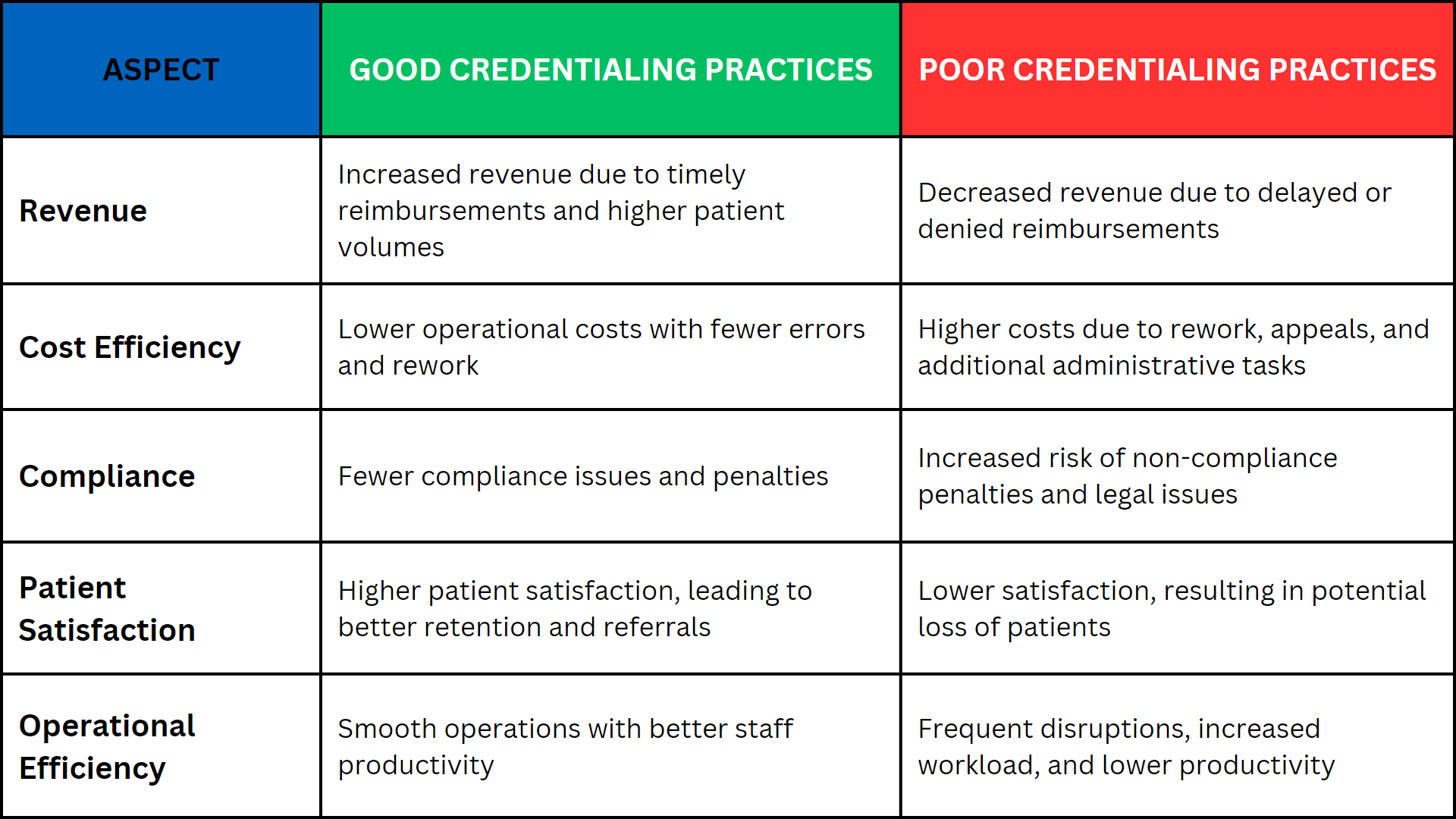
    Financial Impact of Good vs. Poor Credentialing Practices

    Best Practices to Minimize Hidden Costs

    Implement these strategies to optimize your credentialing process:

    1. Centralize Credentialing Operations:
      • Create a dedicated credentialing department or team.
      • Implement standardized processes across all payers and providers.
    2. Leverage Technology:
      • Invest in robust credentialing software.
      • Utilize automated verification services for real-time updates.
    3. Implement Proactive Monitoring:
      • Set up alerts for expiring credentials.
      • Regularly audit credentialing files for completeness and accuracy.
    4. Prioritize Ongoing Education:
      • Keep staff updated on changing regulations and payer requirements.
      • Encourage professional certifications in healthcare credentialing.

    Measuring the ROI of Effective Credentialing

    To justify investments in credentialing, track these key metrics:

    1. Claim Denial Rate:
      • Monitor the percentage of claims denied due to credentialing issues.
      • Set goals for continuous improvement.
    2. Days in Accounts Receivable:
      • Track how quickly you’re paid after submitting claims.
      • Look for improvements as credentialing processes are optimized.
    3. Provider Onboarding Time:
      • Measure how long it takes to fully credential new providers.
      • Aim to reduce this time without sacrificing accuracy.
    4. Audit Performance:
      • Track your performance in payer audits.
      • Use results to identify areas for improvement in your credentialing process.

    Conclusion:

    The hidden costs of poor DME credentialing can significantly impact your business’s financial health and operational efficiency. By recognizing these costs and implementing best practices, you can transform your credentialing process from a potential liability into a strategic asset.

    Investing in proper credentialing is not just about avoiding costs; it’s about creating a foundation for sustainable growth and success in the competitive DME market. As we continue through 2024, those providers who prioritize excellence in credentialing will be best positioned to thrive, building strong relationships with payers, providers, and patients alike.

    How WWS Can Help:

    At Wonder Worth Solutions (WWS), we understand the critical role that effective credentialing plays in the success of DME providers. Our team of experts can help you:

    • Assess your current credentialing processes and identify areas for improvement
    • Implement cutting-edge credentialing technologies tailored to your needs
    • Develop comprehensive training programs for your credentialing staff
    • Create robust quality assurance measures to minimize errors and denials
    • Optimize your credentialing operations for maximum efficiency and ROI

    Let WWS be your partner in transforming your DME credentialing from a cost center into a strategic advantage. Our expertise can help you navigate the complexities of credentialing, reduce hidden costs, and position your business for sustainable growth.

    CTA:

    Ready to uncover and eliminate the hidden costs in your DME credentialing process? Let’s work together to optimize your operations and boost your bottom line. Schedule your Collaborative Discovery Meeting with our credentialing experts today!
    Click here to book: https://calendly.com/wwshcs/wws-collaborative-discovery-meeting

  • Master the intricacies of Medicare DME credentialing in 2024

    Master the intricacies of Medicare DME credentialing in 2024

    Introduction

    As a Durable Medical Equipment (DME) provider, obtaining and maintaining Medicare credentialing is crucial for your business’s success and compliance. In 2024, the landscape of Medicare DME credentialing continues to evolve, presenting both challenges and opportunities for providers. This comprehensive guide will walk you through the latest requirements, help you navigate the Provider Enrollment, Chain, and Ownership System (PECOS), and provide strategies to ensure a successful credentialing process.

    Overview of Medicare DME Credentialing in 2024

    Medicare DME credentialing is the process by which the Centers for Medicare & Medicaid Services (CMS) verifies that your business meets all necessary requirements to provide DME services to Medicare beneficiaries. This process ensures that only qualified, compliant providers can bill Medicare for DME supplies and services.
    Key aspects of Medicare DME credentialing in 2024 include:

    • Adherence to the 30 Medicare Supplier Standards
    • Enrollment through the PECOS system
    • Accreditation by a CMS-approved organization
    • Compliance with all federal and state regulations
    • Regular revalidation of your enrollment information

    Key Changes in Medicare Requirements This Year

    As we navigate through 2024, it’s crucial to stay informed about recent changes in Medicare DME credentialing requirements:

    • Enhanced Scrutiny: CMS has increased its focus on fraud prevention, leading to more rigorous screening processes.
    • Digital Transformation: There’s a greater emphasis on electronic submission and verification of credentials.
    • Telehealth Integration: New guidelines for DME providers offering telehealth services have been implemented.
    • Cybersecurity Standards: Stricter requirements for protecting patient data and maintaining secure systems are now in place.
    • Quality Reporting: Enhanced quality metrics and reporting requirements have been introduced for certain DME categories.

    Navigating the Provider Enrollment, Chain, and Ownership System (PECOS)

    PECOS is the online portal used for Medicare provider enrollment. Here’s a step-by-step guide to navigating PECOS for your DME credentialing:

    1. Create an Account: If you haven’t already, create a PECOS account at https://pecos.cms.hhs.gov/.
    2. Gather Information: Before starting, ensure you have all necessary information, including your NPI, tax ID, and licensure details.
    3. Start a New Application: Choose “DME Supplier” as your provider type when initiating a new enrollment.
    4. Complete All Sections: PECOS will guide you through various sections, including:
      • Identifying Information
      • Practice Location Information
      • Ownership Information
      • Final Adverse Legal Actions/Convictions
      • Billing Agency Information
    5. Upload Supporting Documents: Attach all required documentation, such as licenses, accreditation certificates, and liability insurance proof.
    6. Review and Submit: Carefully review all information before submitting your application.
    7. Track Your Application: Use PECOS to monitor the status of your application and respond promptly to any requests for additional information.

Medicare Supplier Standards: A Deep Dive

Medicare requires all DME suppliers to meet 30 supplier standards. Here’s a closer look at some key standards:

  • Standard 1: Compliance with all applicable federal and state licensure and regulatory requirements.
  • Standard 3: Maintenance of a physical facility on an appropriate site, accessible to the public and staffed during posted hours of operation.
  • Standard 7: Maintenance of a comprehensive liability insurance policy in the amount of at least $300,000.
  • Standard 8: Purchase of a surety bond in the amount of $50,000.
  • Standard 14: Provision of complete and accurate information on the DMEPOS claim form.
  • Standard 25: Active participation in the Medicare program and not under revocation or other sanctions.

[Include a full list or link to all 30 standards]

Common Reasons for Medicare DME Application Denials

Understanding common pitfalls can help you avoid delays or denials. Here are frequent reasons for application rejections:

  • Incomplete or inaccurate information on the application
  • Failure to meet one or more of the 30 supplier standards
  • Lack of required accreditation or licensure
  • Insufficient documentation to support the application
  • Failure to respond timely to requests for additional information
  • Non-compliance with CMS policies and procedures

Strategies for a Successful Medicare DME Credentialing Process

To increase your chances of a smooth credentialing process, consider these strategies:

  • Start Early: Begin the credentialing process well in advance of when you plan to start billing Medicare.
  • Stay Organized: Maintain a detailed checklist of all required documents and information.
  • Leverage Technology: Use credentialing software to streamline document management and track application progress.
  • Educate Your Team: Ensure all staff members understand the importance of maintaining compliance with Medicare standards.
  • Conduct Regular Self-Audits: Periodically review your practices to ensure ongoing compliance with all standards.
  • Seek Expert Assistance: Consider partnering with credentialing specialists who can guide you through the process.

Conclusion

Navigating Medicare DME credentialing in 2024 requires attention to detail, commitment to compliance, and a thorough understanding of the latest requirements. By familiarizing yourself with the PECOS system, adhering to the supplier standards, and implementing strategic approaches, you can successfully obtain and maintain your Medicare DME credentials.
Remember, credentialing is an ongoing process. Stay informed about changes in regulations and be prepared for regular revalidation to ensure your continued participation in the Medicare program.

How WWS Can Help

At WWS, we specialize in guiding DME providers through the complex Medicare credentialing process. Our team of experts stays up-to-date with the latest CMS requirements and can provide:

  • Comprehensive assistance with PECOS navigation and application submission
  • Expert review of your documentation to ensure compliance with all supplier standards
  • Guidance on accreditation and licensure requirements
  • Ongoing support for maintaining your Medicare credentials and preparing for revalidation

Let WWS be your partner in achieving and maintaining Medicare DME credentialing success. Our expertise can save you time, reduce stress, and minimize the risk of application denials or delays.

CTA

Ready to streamline your Medicare DME credentialing process? Schedule an introductory meeting with our experts today! Click here to book your Collaborative Discovery Meeting: https://calendly.com/wwshcs/wws-collaborative-discovery-meeting

  • Maximizing Revenue Through Strategic Contracting and Credentialing

    Maximizing Revenue Through Strategic Contracting and Credentialing

    Introduction:

    Credentialing and contracting a powerful tools for maximizing revenue. In this post, we’ll cover how to assess your existing business strategy and determine whether contracting or credentialing could be the next step toward achieving your goal. We’ll also look at some of the common pitfalls that can derail your effort, and how to avoid them.

    Maximizing Revenue Through Strategic Credentialing:

    Strategic contracting can be a valuable tool for hospitals to optimize revenue.
    Contracting is a business process that involves the exchange of goods or services for money. It’s used by many organizations, including hospitals, as a way to increase revenue by selling services at a higher rate than what they cost.

    Hospitals can maximize their revenue by strategically contracting with other organizations to provide greater value to patients and payers while improving patient experience during hospital stays

    Hospitals can also use data to better understand their markets and provide a higher level of service that patients value. Hospitals have traditionally used contracting as a way to increase revenue by selling services at a higher rate than what they cost. However, with the rise of accountable care organizations (ACOs) and bundled payment, hospitals need to rethink how they contract with payers because it’s no longer just about price, Instead, hospitals should focus on providing greater value while improving patient experience during hospital stays.

    Maximizing Revenue Through Strategic Contracting:

    When you’re looking to maximize revenue, one of the most effective ways to do so is through strategic credentialing. Credentialing is the process of verifying the credentials of an individual or organization to ensure their qualifications are consistent with the requirements of the position. It’s used to determine if an individual is qualified for a specific purpose and can be used in a variety of industries, including healthcare, education, and more.

    Credentialing provides several benefits for both employers and employees:

  • It helps organizations ensure that people have acquired the necessary skills before being hired for certain positions (or promoted). This ensures that teams are comprised entirely of qualified individuals who represent themselves honestly during interviews.
  • It gives job seekers greater confidence when applying for jobs because they know exactly what documents they need from previous employers before starting work–and no longer worry whether those documents will arrive in time.
  • Credentialing Management:

    Credentialing management is a critical component in the revenue cycle management process. It involves ensuring that providers are ready to provide quality care, as well as verifying that they have completed all required training and education.

    Providers need to be credentialed by an organization such as JCAHO or CMS before they can begin practicing medicine at a hospital or clinic. Credentialing managers make sure that providers meet the standards set by these organizations, which helps ensure patient safety while also reducing legal liability for the hospital or clinic if something goes wrong with the treatment provided by an uncertified provider.

    As the healthcare industry continues to grow and evolve, so too do the needs of hospitals and clinics. Credentialing management is essential in maintaining quality care, which can be challenging as more providers enter into the system Credentialing management is a critical component in the revenue cycle management process. It involves ensuring that providers are ready to provide quality care, as well as verifying that they have completed all required training and education. Providers need to be credentialed by an organization such as JCAHO or CMS before they can begin practicing medicine at a hospital or clinic. Credentialing managers make sure that providers meet the standards set by these organizations, which helps ensure patient safety while also reducing legal liability for the hospital or clinic if something goes wrong with the treatment provided by an uncertified provider.

    Revenue Management

    Revenue management is the process of managing revenue to maximize profitability. Revenue management can be categorized into two categories:

  • Strategic Contracting – This refers to the process of negotiating contracts with customers that are in your best interest, while also providing value for them. It also involves ensuring you have the right mix of products and services sold at each customer site so that they are satisfied with what they receive.
  • Strategic Credentialing – This refers to setting up a credentialing program so that you can get paid more money for selling higher-priced products or services (e.g., selling 50% more software licenses).
  • The two categories of revenue management are complementary. For example, strategic contracting can help you increase your money by selling additional products or services to a customer. However, without strategic credentialing (such as setting up a credit card processing system), you won’t be able to take advantage of those higher prices.

    Provider Credentialing

    Provider credentialing is the process of vetting providers for their ability to provide the services required. It also ensures that providers can provide those services promptly.

    Provider credentialing should be considered part of any contracting strategy, as it can help you:

  • Control costs by ensuring that only qualified contractors work on your projects
  • Meet deadlines by selecting only those contractors who have demonstrated their ability to meet – sensitive goals
  • Avoid Project delays by ensuring contractors have the necessary equipment and personnel to perform their work and protect yourself from liability by verifying that each provider has insurance coverage.

    You can maximize revenue with strategic credentialing

    Strategic credentialing is a process that identifies the most suitable providers for your patients. When you implement strategic credentialing, it can help you maximize revenue, reduce costs, and improve patient care.

    The first step in strategic credentialing is to identify how many procedures are performed in your facility each year by different types of providers (e.g., surgeons or independent medical examiners). Next, create a list of all possible providers who perform those procedures–including physicians from other hospitals or doctor’s offices; hospitals; independent practitioners such as radiologists and pathologists; clinical laboratory services companies; pharmaceutical companies with clinical trials programs; medical equipment manufacturers offering equipment used in surgery; etcetera! Then score each provider based on their expertise/experience level relative to the type of procedure being considered (e.g., score 1-5 if they have never done this procedure before). Once you’ve scored each potential provider against all criteria listed above then compare those scores against one another until only one name remains at the top: “This person should do this job!”

    The next step is to contact providers on your list and ask them if they are willing to be considered for a job. Set up interviews with each one, including a discussion about their experience/expertise in this area of medicine and how many procedures they have performed over the last year. Invite them back into the facility for an in-person demonstration of their skills (e.g., allowing them to perform surgery on a cadaver).

    Conclusion:

    We hope that you have found this article helpful in understanding how to maximize revenue. As always, we are here to help you with any questions or concerns that arise when it comes to credentialing and revenue management.