

Answer Summary
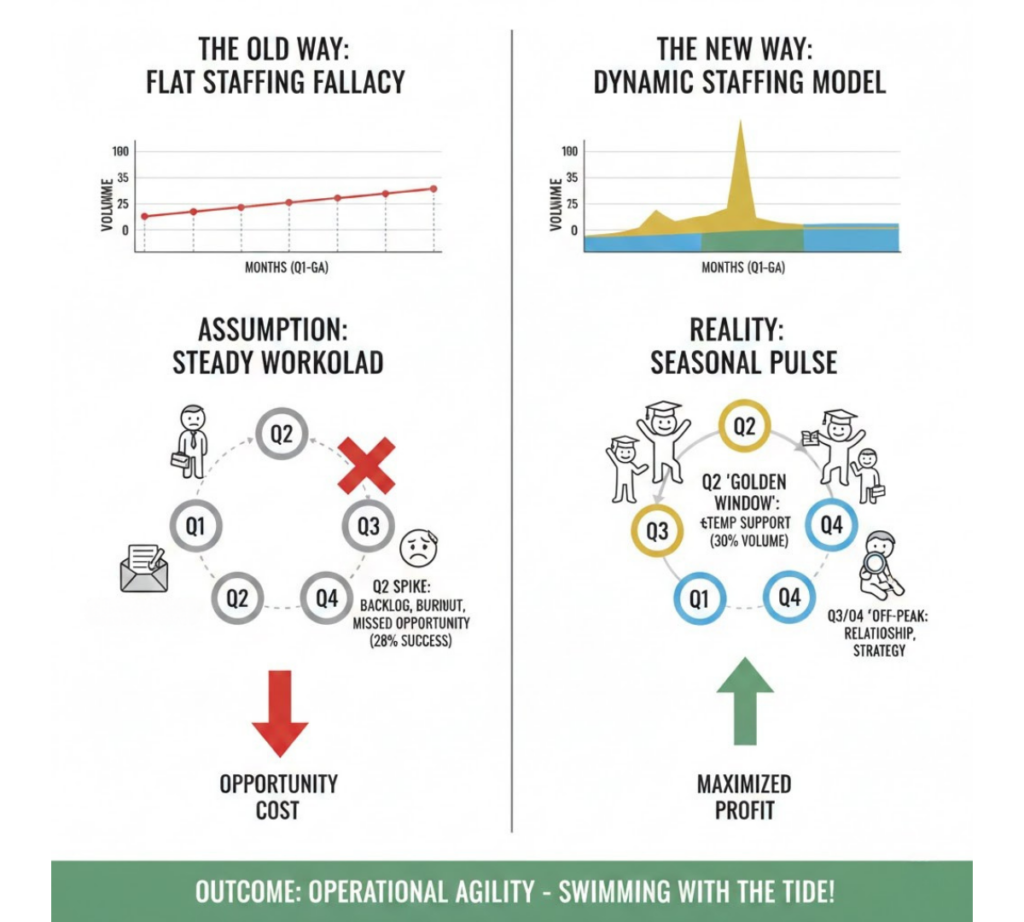
Contracting teams often “drown” in April because 30% of all applications are initiated in Q2, creating a volume spike that traditional flat-staffing models cannot handle during the industry’s most profitable window. Adopting a dynamic staffing model to handle this surge is a critical strategy for 2026 to ensure a 15% reduction in Days Sales Outstanding (DSO) by capturing high-yield contracts when success rates are at their peak. By shifting administrative capacity to match the market’s seasonal pulse, DME providers eliminate backlogs and maximize revenue capture during the “Golden Window” of payer negotiations.
The Scenario: The Flat-Staffing Fallacy
For years, the contracting department operated on a “Flat Staffing” model. They maintained the same headcount and resource allocation in December as they did in May. Management assumed that payer contracting was a steady, year-round activity.
But every Spring, the team fell apart. Backlogs grew, emails went unanswered, and burnout spiked. Leadership blamed “inefficiency,” but the data told a different story.
The Operational Failure
The failure wasn’t laziness; it was Seasonality. Our deep-dive statistical analysis revealed that the contracting market has a distinct pulse that the provider was ignoring.
1. The Volume Spike
Data showed that 30% of all applications are initiated in Q2 (April–June). This is the industry’s “Rush Hour,” likely driven by new fiscal year budgets and network expansion plans.
- The Opportunity: Crucially, Q2 also boasts the highest success rate of the year at 28%.
- The Miss: By staffing Q2 the same as Q4 (which sees only 17% volume), the provider was bottlenecking their most profitable window.
2. The Opportunity Cost
Because the team was overwhelmed during the surge, they couldn’t devote enough attention to follow-ups. High-potential applications were slipping through the cracks during the exact months they were most likely to close.
The WWS Solution: Seasonal Resource Allocation
WWS introduced a Dynamic Staffing Model similar to how retail manages the holiday season.
1. The “Tax Season” Shift
We reclassified Q2 as the “Golden Window.” We adjusted the annual resource plan to shift capacity from the slower Q4 months to Q2.
- Action: We recommended increasing staffing and utilizing temporary support during the April–June surge to handle the 30% volume spike.
2. Off-Peak Strategy
For Q3 and Q4, where success rates naturally drop to 20%, we developed “Maintenance Strategies” focused on relationship building and long-term pipeline management, rather than aggressive submission targets.
The Outcome
The result was Operational Agility. By matching resources to the market’s natural rhythm, the provider maximized contract captures during the high-yield months and used the slow months for strategic planning. We stopped fighting the tide and started swimming with it.